

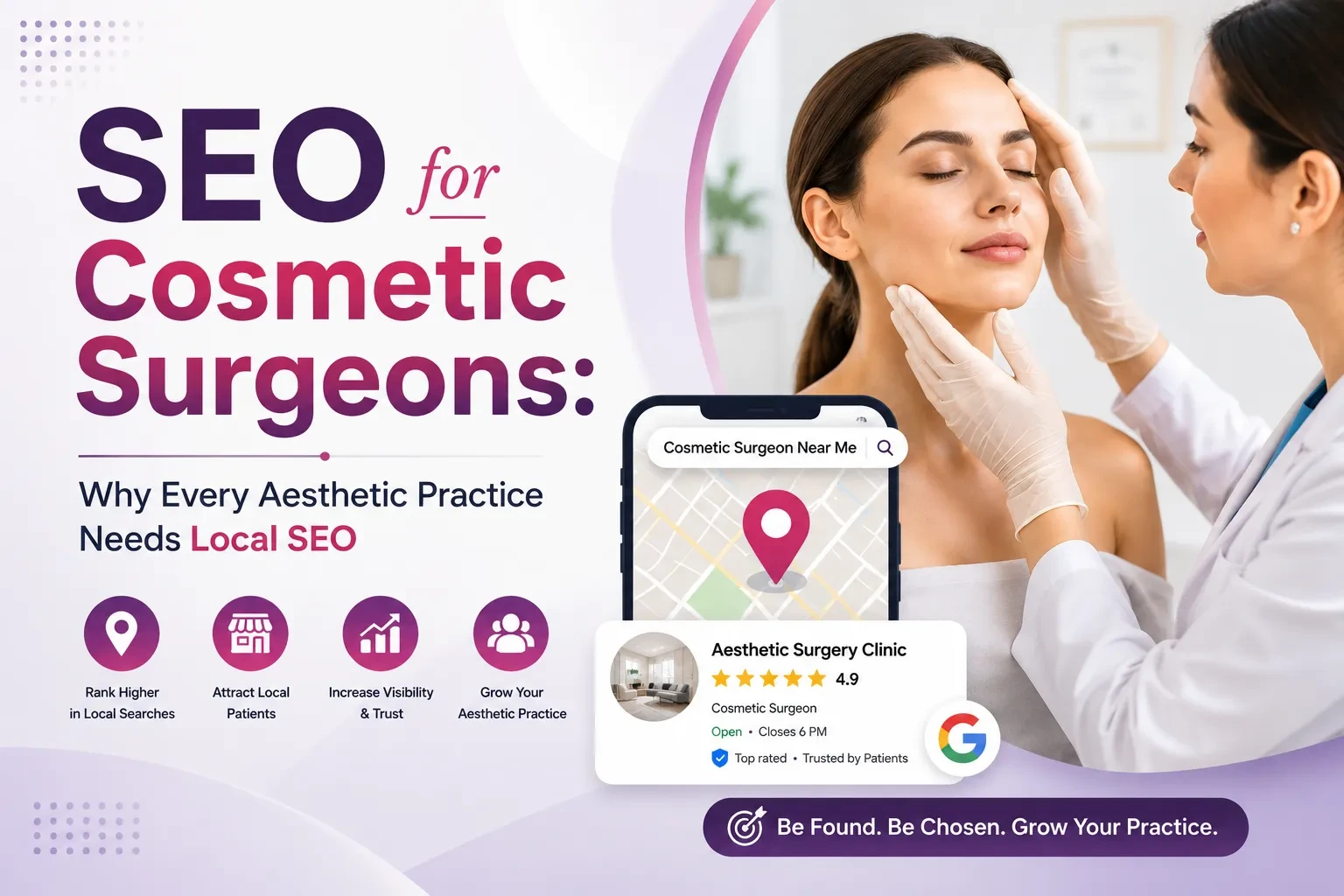
Aesthetic practice SEO, or med spa SEO, is the work of getting your clinic found on Google. It covers your website, your Google Business Profile and your content. The aim is to rank when someone nearby types “Botox near me” or “CoolSculpting in Seattle” and is ready to book. Clinics that win pair technical SEO with local content, a steady flow of reviews and structured data. That mix lets them outrank big chains and listing sites. The goal is not traffic. It is booked consultations.
Med spa SEO comes down to this. Complete your Google Business Profile. Give each treatment its own page. Keep the site fast on phones and add schema markup. Answer the questions patients search. Keep the reviews coming. Do that and a small clinic can outrank a chain, because Google’s local results reward fit and freshness over brand size.
- A complete Google Business Profile is usually what shows first for a nearby search. Real photos and the same name, address and phone on each site make it complete.
- Give each treatment its own landing page. One catch-all “services” page spreads your rankings thin.
- Ask for fresh reviews each month, with the treatment named, so review-heavy rivals stop taking your patients.
- Add schema markup so Google and AI engines can pull your prices, services and reviews straight into the results.
- Grow with local content that answers the exact questions patients type into Google before they book.
Why Aesthetic Practice SEO Matters More Than Ever
Most patients now research treatments and providers on Google before they call a clinic. Someone searching “lip filler near me” or “best med spa in Seattle” is close to booking. Whoever shows first on the map and in the organic results gets that lead, often before a rival knows the person exists. The market is crowded with national franchises, dermatology groups and solo providers. SEO is the difference between being found and being missed.
The Shift From Word-of-Mouth to Search-First Discovery
Aesthetic medicine used to run mostly on referrals and a name built in person. That still matters. But today the first touch for most new patients is a Google search or an Instagram post. It can also be an AI summary of the “top med spas near me” results. Clinics that treat their website and their profile as an afterthought hand that first touch to rivals who invested in it.
This shift also changed what “marketing” means for a med spa. It is no longer a nice website and a few social posts. It is one system. Your profile, your site content, your reviews and your structured data all work together to answer the searcher’s question before they click.
- Search-first behavior. Most cosmetic patients Google a treatment and a place before calling.
- AI Overviews compete for clicks. Google now answers some searches on the page, so your content must be built to get quoted.
- Trust builds before contact. Reviews, before and after photos and provider bios get read before a single phone call.
- Longevity beats spend. Unlike ads, a well-built SEO base keeps bringing leads without a daily budget.
How AI Overviews and AI Search Are Changing the Game
AI Overviews and tools like ChatGPT or Perplexity now answer questions like “how much does Botox cost” or “is CoolSculpting safe” right in the results. Sometimes they cite a clinic or an article as the source. Earning those mentions is called Generative Engine Optimization, or GEO. It rewards content that answers the question clearly, in plain words, at the top of a page or section.
For med spas, this means stuffing keywords into vague service pages no longer works. Content needs to open with a direct answer and back it up with specifics. It also needs a clear structure, so a reader and an AI crawler can both pull out the exact detail they need.
- Answer-first writing. Lead each page and FAQ with a direct, quotable answer.
- Structured data. Use schema markup so AI engines can read your services, price ranges and reviews.
- Authoritative sourcing. Cite credible medical sources, like the American Society of Plastic Surgeons, when you write about safety or whether a treatment works.
Ranking is not the goal. A booked consultation is the only metric that pays your rent.
Local SEO Foundations for Med Spas and Cosmetic Clinics
Local SEO for a med spa starts with three basics. The first is a fully built Google Business Profile. The second is the same business details on each site across the web. The third is a physical or virtual presence Google can verify and trust. Without these, even great content and a beautiful site will struggle to rank in the local map pack. That is where most patients click first.
Google Business Profile Optimization

Your Google Business Profile may be the single most useful asset in aesthetic practice SEO. It is what shows in the map pack for “med spa near me” or “Botox Seattle” searches. It is often the first thing a new patient sees, before they ever visit your website.
A complete, active profile tells Google you are relevant and trusted. Clinics that treat it as a one-time setup, not a living asset, give up reach each month.
- Complete every field. List each service, treatment and your hours, plus a full description with local keywords.
- Post weekly. Regular Google Posts about offers, new treatments or provider spotlights show an active business.
- Upload real photos. Before and after images (with consent), treatment rooms and staff photos beat stock shots.
- Answer every question. The Q&A section is public and searchable, so seed it with the questions patients ask most.
NAP Consistency and Local Citations
NAP stands for name, address and phone number. It needs to match, letter for letter, on each site where your clinic appears. That means your website, your Google profile, Yelp, Healthgrades, RealSelf and every other listing site. Mismatched details confuse Google’s local ranking system and can push you down in the map pack.
Matching listings matter even more for a clinic with several locations, or one that serves a wider area like the greater Seattle region. Google is trying to match your business to the exact place the searcher has in mind.
- Audit existing citations. Search your clinic name and fix old addresses or phone numbers on listing sites.
- Prioritize industry directories. RealSelf, Healthgrades and Vagaro carry real weight for med spas and medical clinics.
- Claim every listing. An unclaimed profile on Yelp or Bing Places is a missed chance and a risk of mismatched details.
| Channel | Time to Results | Cost Over Time | Longevity |
|---|---|---|---|
| SEO | 3 to 6 months | Moderate, front-loaded then compounding | Long-term asset, keeps working |
| Google Ads (PPC) | Immediate | High, ongoing per click | Stops the moment you stop paying |
| Social Media (Organic) | Weeks to months | Low to moderate | Requires constant content output |
| Social Media Ads | Immediate | Moderate to high, ongoing | Stops the moment you stop paying |
On-Page and Technical SEO for Aesthetic Websites
On-page and technical SEO for a med spa website means two things. First, build a keyword-targeted page for each treatment. Second, make sure the site loads fast, works on a phone and is laid out so Google and AI engines can crawl and understand it. A single catch-all “services” page cannot compete with a well-built page devoted to, say, CoolSculpting or microneedling.
Service-Specific Landing Pages
Each treatment you offer deserves its own page: Botox, dermal fillers, laser hair removal, chemical peels. Each page needs its own content, price guidance, before and after photos and FAQs for that treatment. This is one of the clearest splits between clinics that rank and clinics that do not.
A catch-all page that covers ten treatments in five hundred words weakens the fit for each keyword.
Compare two pages. One is a vague “our treatments” page. The other is a focused “Botox in Seattle” page that answers cost, downtime and who is a good candidate. The focused page wins, and keeps winning. It matches what the searcher typed and gives the answers they came for.
- One page per treatment. Separate URLs for Botox, fillers, laser resurfacing, body contouring and the rest.
- Include pricing ranges. Even rough ranges cut bounces and give searchers what they came for.
- Add treatment-specific FAQs. Cover downtime, pain level and when results show on each page.
- Use descriptive URLs. A URL like /botox-seattle/ beats a catch-all /services/ page for local intent.
Site Speed, Mobile Experience, and Core Web Vitals
Site speed and ease of use on a phone are direct ranking factors. Med spa sites are prone to slowdowns from large, heavy before and after images. A slow gallery page can sink your rankings even when the content is great.
Most patients research cosmetic treatments on a phone, often at lunch or in the evening. If your site takes more than a few seconds to load, or is hard to use on a phone, they leave. They go back to the results and tap a rival instead.
- Compress images. Before and after galleries should use light, web-friendly file formats.
- Test on mobile first. Design for the phone first, not the desktop.
- Monitor Core Web Vitals. Use Google Search Console to catch loading and response problems early.
Schema Markup for Medical and Local Businesses
Schema markup is structured code added to your site. It tells Google and AI engines exactly what your business does, which services you offer and what patients say about you. For a med spa that means LocalBusiness, MedicalBusiness, Service and Review schema.
This matters more and more for GEO, because AI tools lean on clean, well-tagged data to give accurate answers. A clinic with clean schema is far more likely to be cited in an AI assistant’s answer. Think of questions like “what’s a good med spa near me” or “how much does CoolSculpting cost.”
- LocalBusiness schema. Sets out your name, address, hours and service area.
- Service schema. Tags each treatment page so search engines can tell one offering from another.
- Review schema. Shows star ratings right in the search results, which lifts click-through.

Content Strategy That Turns Searchers Into Patients
A content strategy that works for a med spa means three things: blog posts, treatment guides and FAQ pages. Each one answers a question patients already type into Google. It does not mean vague wellness content that ranks for nothing of value. Content built on real search intent does two jobs. It ranks, and it pre-sells the patient before they book.
Answering the Questions Patients Actually Search
The most valuable content answers exact, high-intent questions. How much does it cost, how long does it last, is there downtime, and am I a good candidate? These show up all the time in Google’s “People also ask” boxes and in AI Overviews. Clinics that answer them clearly and honestly earn rankings and trust.
Content that hedges, oversells or dodges specifics does worse with readers and with AI tools alike. Both favor direct, confident answers backed by credible facts.
- Cost and pricing guides. Open pricing content ranks well and cuts inquiries from people who were never a fit.
- Recovery and downtime breakdowns. Spell out what to expect day by day after a procedure.
- Candidacy content. Explain who is and is not a good fit for a treatment, which builds trust.
- Comparison content. Pages like “Botox vs. Dysport” or “CoolSculpting vs. SculpSure” catch people still doing research.
Location Pages for Multi-Area Practices
If your clinic serves several neighborhoods, cities or a wider metro area, location pages help you rank for very local searches. Each page needs its own content about that place, not a pasted template with the city name swapped.
Take a Seattle clinic that also serves Bellevue, Tacoma and the Eastside. Bellevue gets its own page, and so do Tacoma and the Eastside. Each page is written for that place, with its own neighborhoods, parking details and nearby landmarks.
Franchise med spas often get this wrong. They run near-identical location pages across dozens of cities. A page written for its place, with real local references, consistently beats the template.
- Write unique copy per location. Do not reuse the same paragraph with only the city name changed.
- Reference local landmarks. Mention neighborhoods, cross streets or well-known nearby businesses.
- Embed a local map. A Google Map embed backs up that page’s local fit.
Reviews, Reputation, and Trust Signals
Reviews shape both local rankings and patient decisions. Google weighs how many reviews you have, how recent they are and what they say. And patients weighing an elective cosmetic procedure lean hard on social proof before they book. A clinic with dozens of recent, detailed reviews will keep outranking one with a handful of old ones. That holds even when the older clinic’s website is stronger on the technical side.
Generating a Consistent Flow of Reviews
The review strategy that works is a simple, repeatable system built into your patient workflow, not a one-time push. Clinics that ask each happy patient for a review, right after a good treatment, keep beating those that ask now and then, or never.
Send an automatic text or email after the appointment, with a direct link to your Google review page. It removes the friction and lifts response rates a lot.
- Automate the ask. Send a review request text or email within 24 hours of the appointment.
- Make it one click. Link straight to your Google review form. Do not make patients search for you.
- Respond to every review. A thoughtful reply, above all to a negative review, builds trust with the next reader.
- Encourage specifics. Ask patients to name the treatment they had. It helps with keyword match.
Before/After Galleries and Visual Trust Signals
Before and after galleries are among the strongest trust and conversion tools a clinic has. They let a new patient see real results instead of trusting marketing copy alone. They also tend to earn strong engagement and time on page, both good signals for SEO.
Always get proper written consent. Where you can, add brief context: the treatment used, the number of sessions and the timeframe. That detail satisfies a curious patient and a search engine looking for depth.
- Get documented consent. Never publish patient photos without clear, written permission.
- Add context per photo. Note the treatment, session count and timeframe so people know what to expect.
- Organize by treatment. Separate galleries for Botox, fillers and body contouring make the site easier to browse and help SEO fit.

Outranking Big Chains and Franchise Med Spas
An independent clinic can outrank a national chain or franchise med spa. The way to do it is to lean into local fit, provider expertise and real patient trust signals. Those are the areas where big, templated franchise sites are weak by design. Chains often have more domain authority. They rarely have the local depth, the provider content or the real review volume a well-run small clinic can build.
Where Franchise Websites Are Weak
National med spa chains usually run one central website template across each franchise location. So each location page is often thin, copied or vague. Google’s ranking favors unique, locally relevant content more and more. That gives a small clinic a real opening if it invests in it.
Franchises also tend to skimp on provider bios and personal trust content. Their model leans on the brand name, not on any one injector’s or aesthetician’s reputation.
- Thin location pages. Templated content with little local detail.
- Generic provider info. Little on each injector’s training or experience.
- Slower content updates. Corporate sign-off delays new content and any response to a trend.
Building a Localized Authority Advantage
A small clinic competes best by doubling down on what a franchise cannot easily copy. That means deep local fit, each provider’s track record, and a review and content strategy that responds fast. It is the same approach Kihan Marketing has used with its med spa and wellness clients.
Publish detailed local content, keep your Google Business Profile active and keep earning fresh reviews. Do that and you will often outrank a chain with ten times the domain authority. Google’s local ranking rewards fit and freshness over brand size alone.
- Feature provider credentials. Put certifications, years of experience and specialties up front.
- Publish local, timely content. Cover seasonal trends, local events or a new treatment you now offer.
- Maintain review velocity. Steady monthly reviews beat a large but stale total.
- Use internal linking. Link treatment pages, location pages and blog posts to each other to build topical authority.
Frequently Asked Questions
How long does SEO take to work for a med spa or aesthetic practice?
Most med spas see real movement in local rankings within 3 to 6 months. Bigger gains, above all on crowded keywords, take 6 to 12 months. A clinic in a less crowded metro or a smaller city often sees results sooner than one in a dense market.
What is the difference between SEO and paid ads for a med spa?
SEO builds lasting organic reach that keeps bringing leads with no per-click cost. Paid ads like Google Ads bring reach at once but stop the moment the budget stops. Most clinics that do well use both: ads for volume now, while SEO compounds in the background.
How much does aesthetic practice SEO cost?
It depends on how crowded your market is and how much work the site still needs. A clinic in a dense metro, up against chains, needs more content, more local work and more patience than one in a smaller market. Scope follows competition, not the other way around. Read more on our pricing page.
Is there a free way to do aesthetic practice SEO?
Yes, a clinic can start for free. Fill out the Google Business Profile in full and ask happy patients for reviews. Make sure the site works on a phone, and write helpful treatment FAQ content. These steps cost time, not budget. They can lift local reach well before you spend on paid work.
What keywords should aesthetic practices target?
Target a mix. Keywords that pair a treatment with a place, like “Botox in Seattle” or “CoolSculpting near me,” catch people ready to book. Question keywords like “how long does lip filler last” catch people still doing research, earlier in their decision.
Do reviews actually affect SEO rankings for med spas?
Yes. Review count, recency and quality are direct local ranking factors for your Google Business Profile. They also sway whether a new patient clicks through and books. That makes reviews one of the most valuable assets a clinic can build.
How do I optimize my aesthetic practice website for AI search like ChatGPT or Google AI Overviews?
Answer each question directly and briefly near the top of the page. Add schema markup so AI tools can read your services and reviews correctly. Cite credible sources when you discuss safety or medical claims. That is the core of Generative Engine Optimization, and it overlaps a great deal with solid traditional SEO.
Can a small independent med spa really outrank a national chain?
Yes. Independent clinics often outrank national chains in local search. Google’s local ranking rewards real local fit, each provider’s track record and fresh review activity. Large franchise sites built on templates fall short in all three.
What does a med spa SEO audit cover?
An audit checks the basics in this guide. Is the Google Business Profile complete? Does each treatment have its own page? How fast does the site load on a phone? Is schema in place, do the listings match, and how do the reviews compare with the clinics above you? Kihan Marketing also offers a free marketing audit of your site.
How is SEO for med spas different from general SEO?
Most of the demand is local and tied to a treatment. So med spa SEO leans on the map pack, a page per treatment and listing sites like RealSelf and Healthgrades. Trust carries more weight: reviews with the treatment named, before and after photos with consent, provider credentials and medical schema.
What should a med spa look for in an SEO agency?
Ask how they would handle the pieces in this guide. Will they build a page for each treatment? Is the profile work ongoing or a one-time setup? Will they build a review system into your patient workflow, add schema markup and write each location page for its place? If the plan is a package of generic blog posts, keep looking.
Turning SEO Into Booked Consultations
Aesthetic practice SEO is not about chasing rankings for their own sake. When someone searches for a treatment you offer, your clinic should be the one they find, trust and call. That holds in Seattle or anywhere across the country. It takes a complete Google Business Profile and a landing page per treatment. It takes a site fast enough not to lose patients on a slow gallery. And it takes content that answers real questions and a steady stream of real reviews.
Independent clinics hold a real edge over national chains once they commit to this. Local fit, each provider’s track record and real patient trust are exactly what templated franchise sites struggle to copy. Want to see where your clinic’s SEO stands today, and what it would take to outrank the clinics above you? That is the audit we run before we start work with a new med spa client.
Want to know where your site stands? Ask for a free marketing audit.