



Local SEO for contractors decides who gets the call when a homeowner nearby searches for the work you do. Most local clicks go to the Google local pack: the map and three listings at the top of the page. This guide shows how that block is decided and how to win it.
Winning local search is two jobs. Near your address, you win the map pack with a complete Google Business Profile, steady reviews and consistent listings. In the cities beyond it, you win the organic results below the map with a useful page for each city you really serve. Most contractors only do the first job.
TL;DR
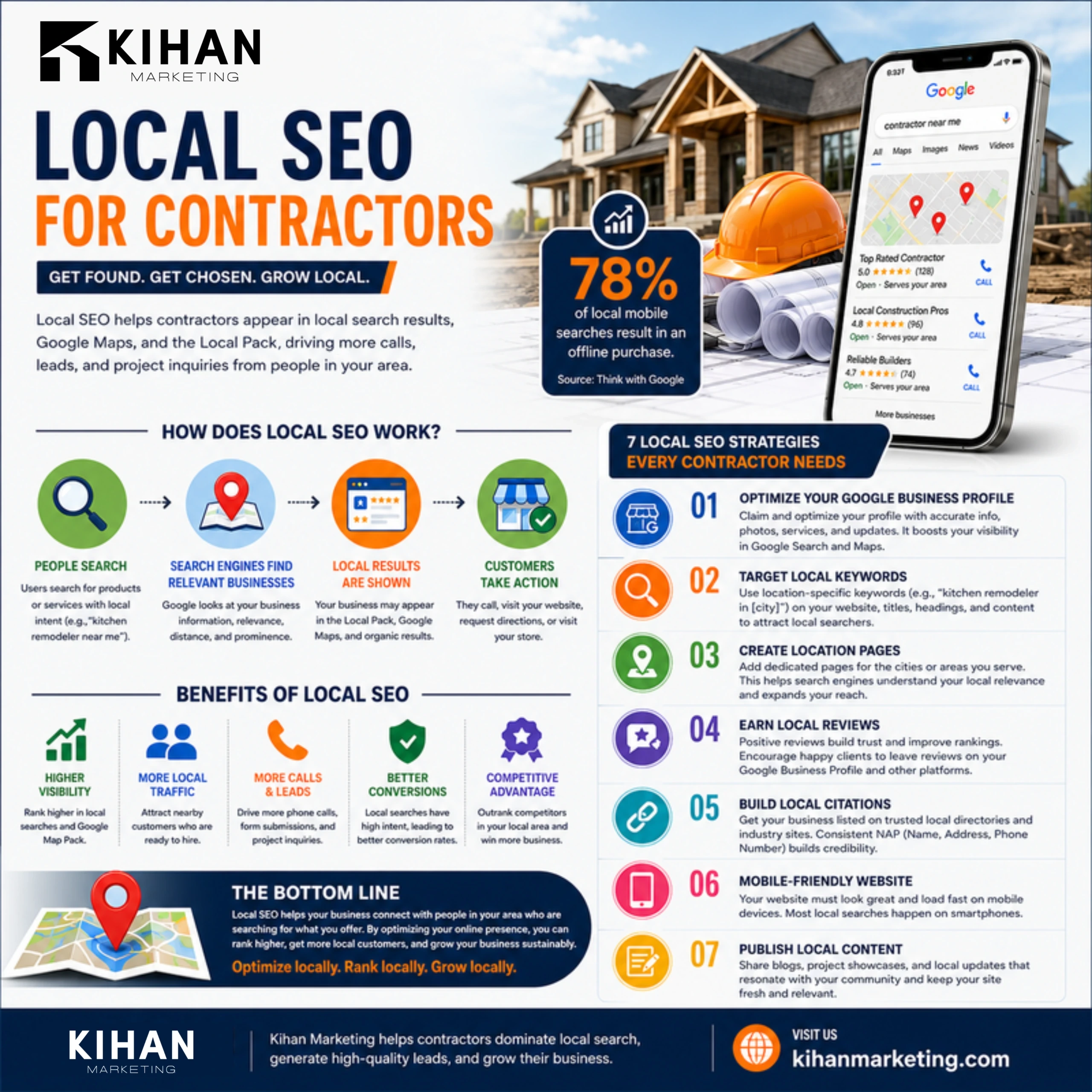
To rank in the Google Map Pack, contractors need four things. The first is an optimized Google Business Profile. Then come consistent NAP citations, which list your name, address and phone the same way on other sites. Add a steady flow of recent reviews and a website page for each location. Nearly half of all Google searches have local intent, meaning the searcher wants something nearby. The map pack takes most local clicks, so winning it is the move that pays back most for a contractor.

What the Google Map Pack Is and Why It Matters
When someone searches “plumber near me,” the Map Pack is the block of three local businesses, with a map, at the top of the results. A large share of local searches never make it past that block to the regular results below. For a contractor, ranking there is the difference between a full schedule and an empty one. It’s the foundation of local SEO.
Optimize Your Google Business Profile

Your Google Business Profile powers the Map Pack. To win it, set the correct primary category. Fill in every service and your service-area settings. Add real photos of your work and your crew, and keep your hours accurate. Google rewards relevance, proximity and prominence, and a complete, active profile signals all three.
Treat the profile as a living asset, not a listing you set up once and forget. Post updates, answer questions and keep the details current.
Reviews and Citations
Reviews are one of the strongest local ranking signals. They are also one of the most persuasive things a customer reads. Ask every satisfied customer. Make it one tap with a direct link, and reply to each review.
Pair that with a consistent NAP (name, address, phone) across directories, so Google trusts your business data. Volume and recency both matter, so a steady drip beats a one-time push.
Location and Service Pages
Back your profile with website pages that match what people search. That means a page for each core service and each city you serve. Each one should be truly useful, not a thin template. These pages add relevance for the Map Pack and win the organic results beneath it. Done well, they make your site the local authority. That is the goal of any lasting local SEO strategy.
New to the topic? Start with what local SEO is and how it works.
Related reading
- Local SEO vs National SEO: What’s the Difference?
- Google Maps SEO: 11 ways to improve your local business visibility
How the Google Local Pack for Contractors Is Decided
Google publishes the three factors behind local results. For a contractor, each one behaves differently than it does for a shop.
- Relevance. How well your profile matches the search. Your primary category is the one field that moves this most. Most contractors have it set to something broader than the work they actually want.
- Distance. How far you are from the searcher. A contractor works across a service area far wider than the radius one verified address can carry. That gap is the central problem of local SEO for contractors.
- Prominence. How well known you are: your reviews, your mentions and the strength of your site. It is the slowest factor to move and the hardest for a competitor to copy.
So the cities near your address are won in the map pack. The cities beyond it are won in the organic results underneath. Those are two different jobs, and most contractors only do the first.
Map SEO for Contractors: Setting Up the Profile Correctly
- Hide the address if customers do not come to you. Set service areas instead. Showing an address customers cannot visit is against Google's guidelines. It puts the profile at risk.
- Set the primary category to the work you want most. Pick that, not the broadest one that covers everything. Changing it changes which searches you show up in.
- List every service individually. Not a summary. Name each service the way customers name it.
- Add real photographs, regularly. Crews, trucks and finished work. No stock images, and not just once at setup.
- Answer the questions section yourself. Anyone can answer it, including people who do not work for you. Post the questions you get asked, and answer them before someone else does.
Winning the Cities Beyond Your Map Radius
Service areas on a profile do not stretch your reach the way people hope. Proximity still applies. Listing twenty cities does not put you in twenty map packs.
- Build a page for each city you really serve. The organic results below the map have no proximity rule. That is where the outer half of a service area is won.
- Put something on each page only you could write. Name the neighborhoods you have worked in. Cover the housing stock and its typical problems, and the permit realities. Show photos of your own jobs there.
- Cross service with city, in priority order. Start with the work you most want, in the places you most want it. Broad coverage of everything comes later.
- Link them into a hub and to each other. Orphan pages, which no other page links to, get crawled unreliably. They rank that way too.
- Publish only what you can make specific. A smaller set of real pages beats a large set of near-duplicates.
Reviews, Which Decide More Than Contractors Expect
Reviews feed the prominence signal that decides map results. They are also what a homeowner reads before letting someone into their house. For contractors, both effects point the same way.
What works is a fixed moment. The person who finished the work asks for the review, and a text with the direct link follows the same day. Asking only now and then, or leaving it for the office to chase later, is why most contractors have fewer reviews than the competitor above them.
How Long Local SEO Takes for Contractors
Profile work often shows movement within weeks, because it is a fast lever. City and service pages follow the normal curve. They get indexed in days to weeks. Impressions, meaning how often you appear in results, move in the first month or two. Real position change comes around sixty to ninety days.
Local SEOGoogle Business Profile work, map pack rankings and location pages for customers searching nearby.FAQ: Local SEO for Contractors
How do contractors rank on Google?
Optimize your Google Business Profile, build consistent citations and collect recent reviews. Then publish useful service and location pages to win both the Map Pack and the organic results.
What is the Google Map Pack?
It is the top three local business results, shown with a map, for local searches. It captures most local clicks.
How do I get more Google reviews for my business?
Ask every happy customer and send a direct review link, so it takes no effort. Reply to each review. A steady habit beats a one-time push.
How long does local SEO take for contractors?
Google Business Profile gains can show in weeks. Broader local rankings usually build over 3 to 6 months.
How do contractors rank in the Google local pack?
Through the three factors Google publishes. Relevance comes from your primary category and service list. You cannot change your distance from the searcher without an address there. Prominence is built slowly, by reviews and your site’s strength.
Can a contractor rank in cities where they have no address?
In the organic results below the map, yes, with a page that says something real about the work you do there. In the map pack itself, largely no. Proximity is one of the three factors, and it is the one you cannot influence.
Do service areas on a Google Business Profile extend my reach?
Less than most contractors expect. Google still weighs distance to the searcher, so adding twenty service-area cities to your profile does not put you in twenty map packs. Set the areas you actually work in, then use city pages to reach the rest.
How many reviews does a contractor need?
There is no threshold. Compare yourself with the contractors ranking above you in each area, and watch recency. A steady trickle reads better to both Google and a homeowner than a large number that stopped two years ago.
What is local SEO for contractors?
It is the work that makes a trade business show up when people nearby search for that trade. It covers two places on the results page: the map pack at the top and the organic results below it. Your profile, reviews and listings drive the first. City and service pages drive the second.
How much does local SEO for contractors cost?
It depends on how much work your market needs. The cost moves with how many services and cities need their own pages, and how complete your profile already is. It also moves with how far ahead the contractors above you are. See our pricing page, or start with a marketing audit.
Jump to a section