

SEO vs social media marketing is really a question of where your effort goes first. This guide shows what each one does, when each one wins, and how to run both without doing either badly.
Start with SEO if people already search for what you sell. It catches buyers at the moment of need, and a page that ranks keeps working. Add social media next, to reach people who are not looking yet and to make your name familiar. Run both from one piece of thinking, not two programs.
TL;DR
For most small businesses, SEO is the better first investment. It captures people who are actively searching for what you sell. Social media is better for awareness and building a brand. SEO compounds into traffic you own, while social reaches people who are not searching yet. Start with SEO to capture demand, then add social to generate it.

The Core Difference: Capturing vs Generating Demand
SEO captures demand that already exists. Social media generates demand: it puts your brand in front of people who were not looking yet. Both matter, but they solve different problems.
Someone already wants a plumber and types “plumber near me.” That is demand that already exists. When people already search for what you offer, capturing that demand with SEO is almost always the faster path to revenue.
When SEO Wins
SEO wins when your customers search for your service. It also wins when you want traffic that compounds, and leads you do not pay for per click. A page that ranks keeps producing leads month after month. For service and local businesses especially, that high-intent traffic you own is the strongest foundation for lead generation.
When Social Media Wins
Social media wins for awareness, for visual products, and for building trust over time. It is where you show personality, before-and-afters and proof. The catch is that social traffic is rented and attention is fleeting. So social works best as a layer that generates demand on top of a search foundation. It should not be your only channel.
How to Sequence Both
Lead with SEO to capture the people already searching. Then add social to generate demand and stay top of mind. As both grow, they reinforce each other: social builds the brand that makes people click your search result. Put your budget where the intent is highest first, then expand.
Related reading
- TikTok/Reels Series: ‘Things My Renters Did This Week (Kirkland Edition)’
- LinkedIn Marketing for B2B: Organic Growth Tactics
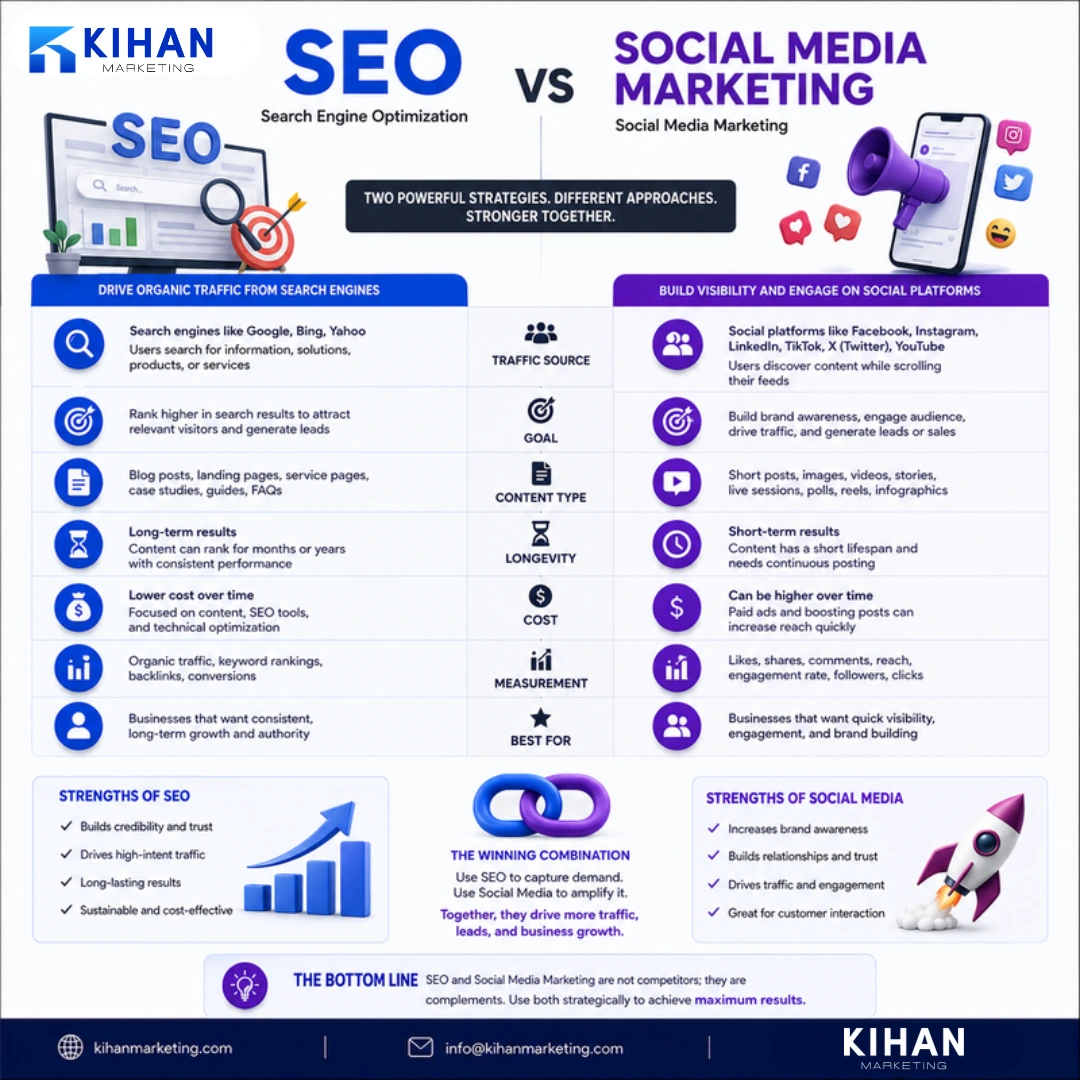
SEO and Social Media, Side by Side
The two are often compared as if they were two ways of doing the same thing. They are not. One captures demand that already exists. The other creates attention among people who were not looking.
| SEO | Social media marketing | |
|---|---|---|
| The person's state of mind | Actively searching for a solution | Scrolling, not looking for you |
| What you are doing | Being found at the moment of need | Interrupting pleasantly enough to be remembered |
| Time to first result | Weeks to months | Days, and faster with paid distribution |
| What happens when you stop | Traffic drifts down slowly | Reach stops almost immediately |
| Cost shape | Fixed monthly, cost per lead falls over time | Ongoing, and rises as you reach beyond your existing audience |
| What you own | Pages, rankings and the site | The audience list, if you move it somewhere you control |
How to Choose SEO or Social Marketing for Your Business
The honest deciding question is simple: do people already search for what you sell?
People search for it by name. Think plumbers, dentists, lawyers, roofers and software categories. The demand exists, and someone else is capturing it. SEO first, every time.
Nobody knows the category exists yet. This is a new product type, an unusual service, or anything you have to explain before people want it. Social first, because there is no search demand to capture.
The purchase is visual and impulsive. Think apparel, food, interiors, anything bought because it looked good. Social carries more of the work. Search catches the people who go looking afterwards.
The purchase is considered and researched. It is high value, with a long decision and several people involved. Search dominates, and social supports it by making the name familiar.
You need something this month. Neither organic channel is fast. That calls for paid search or paid social, with SEO built underneath so the paid spend can come down later.
Using Social Media Marketing for SEO, and Where the Link Actually Is
Social posts do not directly raise rankings. Links on social platforms are almost always marked so they pass no ranking signal. Google has also been consistent that follower counts are not a ranking factor.
The connection is indirect, and real anyway. Content that circulates on social gets seen by people who then link to it from their own sites, and those links do count. Social also raises branded search, meaning searches for your name. A page that people look for by name behaves differently from one they stumble into. Treat social as distribution for work that earns links, not as a ranking lever in itself.
Running Both Without Doing Either Badly
Write for search, cut for social. The page answers the question in full. The post is the sharpest paragraph from it, rewritten to stand alone. One piece of thinking, two formats.
Let social tell you what to write next. The questions people ask in replies and comments are search queries in plain clothes. They are the cheapest keyword research there is.
Send social traffic to a page you own. Do not send it to a link in bio that goes nowhere useful. Every post that earns attention needs somewhere for that attention to land.
Measure them differently. Search is measured in impressions, position and clicks in Search Console. Social is measured in reach, saves and the traffic it actually sends. Judge one by the other’s numbers and both look like failures.
What Each Costs
For most small businesses, search is the base, because it compounds and you keep it. Give social the time you can actually sustain, not what a content calendar template says you need.
SEO and AI SearchLocal, technical, schema and AI search work, for businesses whose customers are already searching.FAQ: SEO vs Social Media
Is SEO or social media better for small business?
SEO is usually the better first investment, because it captures active demand. Social media is better for awareness. Most businesses end up using both.
Is social media marketing worth it?
Yes, for awareness, trust and visual products. But for service businesses it rarely drives as many leads per dollar as search does.
Which is cheaper, SEO or social media?
Over time, usually SEO. Its cost per lead falls as pages that rank keep working. Social needs constant new content, and often paid boosting, to stay visible. What moves the cost is how much content each needs and how far past your existing audience you want to reach. See the pricing page for how the work is scoped.
Can I do SEO and social media together?
Yes, and they reinforce each other. Lead with SEO to capture demand, then layer social on top to generate it.
What is the difference between SEO and social media marketing?
SEO captures demand that already exists, by being found when someone searches. Social media creates attention among people who were not looking. One compounds and you keep it. The other stops when you stop posting or paying.
Does social media marketing help SEO?
Not directly. Social links generally pass no ranking signal, and follower counts are not a ranking factor. The indirect effect is real, though. Content that circulates gets linked from other websites, which does count, and it raises branded search.
Should a small business invest in SEO or social media first?
If people already search for what you sell, SEO first, because someone else is capturing that demand right now. If nobody knows the category exists, social first, because there is no search demand to capture yet.
Can you do both on a small budget?
Yes, if they share one piece of thinking. Write the page properly for search, then cut the sharpest part of it into posts. What fails is running two separate content programs at half strength each.
Jump back to a section