

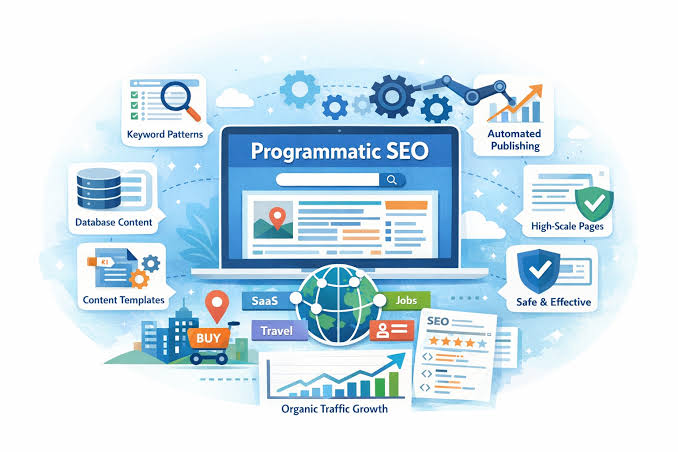
Programmatic SEO means building many pages from one template and one set of data. This guide covers what it is, when it works, the thin-content risk and whether your business should use it. Quick answers sit in the FAQ at the end.
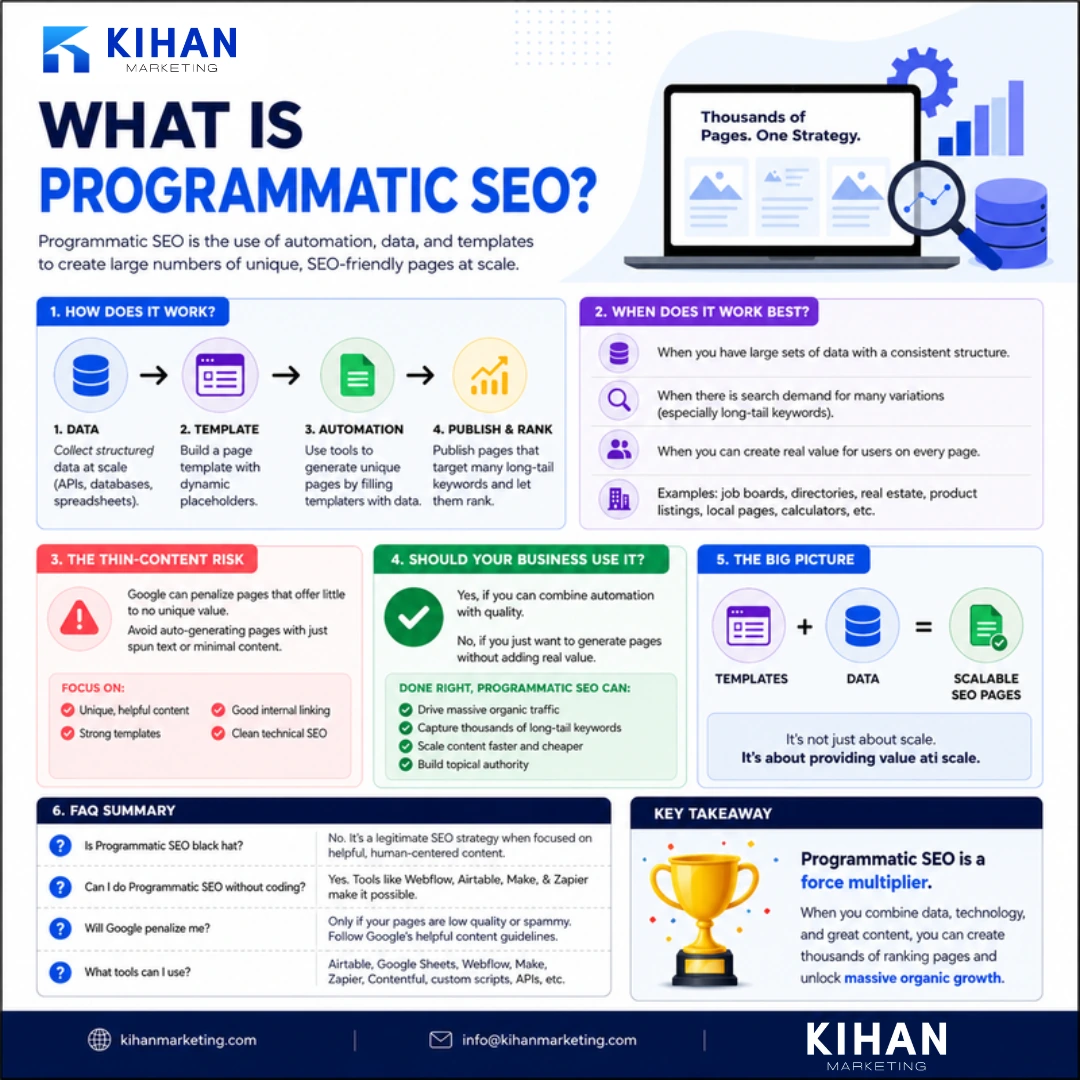
Programmatic SEO builds many pages from a template and a data source, such as a page for each service in each city. It works when every page has real data and real searches behind it. It backfires when the pages are thin copies of each other. Most small businesses should use it sparingly and give every page something unique.
TL;DR
Programmatic SEO is the practice of creating many pages at scale from a template and a data source. Think of “[service] in [city]” pages. It works when you have real, useful data and real search demand for each page. It backfires when pages are thin and duplicate each other. Most small businesses should use it sparingly, with unique value on every page.

What Programmatic SEO Is
Programmatic SEO builds many pages automatically. It combines a template with a dataset, for example a page for every pairing of service and city. Done well, it lets you target hundreds of specific searches without writing each page from scratch. The key word is “well.” The method rewards real value and punishes thin, copy-paste pages.
When It Works
Programmatic SEO fits when you have real, useful data and real search demand for each variation. Common programmatic SEO examples are location pages, comparisons and directories. Each page must answer a real query with something unique. With that in place, you can grow your visibility across many long-tail searches at once. Long-tail searches are longer, more specific phrases.
The Thin-Content Risk
The danger is mass-producing near-identical pages that only swap a city name. Google penalizes thin, duplicate content, and these pages can drag down your whole site. If a page would not help a person on its own, it should not exist. Quality per page beats raw quantity every time.
Should Your Business Use It?
Most small businesses should use programmatic SEO sparingly. Use it only where you can give each page real, unique value. True location pages for areas you actually serve are a good example. If you cannot make each page useful, a smaller set of strong pages will serve you better. When in doubt, put quality first. Let website development give you a clean structure that search engines can crawl.
Related reading
- Seattle Single-Family Lots Can Now Hold 4 Units, Most Owners Don’t Know
- Small Business SEO: 12 Practices to Outrank Bigger Competitors
- SaaS Marketing for Small Teams: Channels That Compound
How a Programmatic Page Set Is Actually Built
This work is less about generating pages and more about what you decide first. There are five steps, in order. Skipping the third is the usual reason a set fails.
- Pick a data source you actually own. Every page needs a fact that belongs to it. That could be service areas you truly cover, products with real specifications or treatments with real prices. If only a place name changes between pages, stop here.
- Write the template around the variable, not the other way around. A good template has three or four places where the unique data does real work. The first is the heading. The second is an opening paragraph that answers the specific query. The third is a section that only makes sense for that variant, and the fourth is the internal links. Everything else is shared, and it should be.
- Add something per page a competitor cannot copy. For a service area, that could be local landmarks and drive times. It could be real turnaround times or photos of actual work. Most programmatic sets skip this step. Yet it is the step that decides whether the pages rank.
- Link the set into the site, and to each other. Orphan pages, the ones no other page links to, do not get crawled reliably. Each generated page should be reachable from a hub page. It should also link to its nearest siblings.
- Control what gets indexed. Generate more than you publish. Publish the variants with real demand. Keep the rest out of the index until they earn a place.
Questions to Answer Before You Generate a Single Page
If any of these has no good answer, the set is not ready. It is cheaper to find that out now than after three hundred pages are live.
Is there search demand for each variation?
Check each variation, not just the category. "Roofing in Austin" may have demand while "roofing in a suburb of 4,000 people" has none.
Can you say something specific on every page?
Write three pages by hand first. If that is already a struggle, three hundred will be worse, not easier.
Does the page type carry a local pack?
Sometimes a map pack, the map with local business listings, fills the results for your target phrase. If you have no verified address in that area, ranking the page is far harder than the volume suggests.
Who maintains this in a year?
Prices change, service areas change and staff change. A set nobody updates turns into a set of stale pages.
When Programmatic Beats Writing By Hand
The choice is not a matter of belief. It depends on how much real, per-page data you have.
| Situation | Better approach | Why |
|---|---|---|
| Five to ten service areas you truly serve | Write them by hand | Ten strong pages beat a hundred thin ones, and you can say something real about each |
| Hundreds of product or spec combinations with real data | Programmatic | The data itself is the unique value, and no human could write them all |
| Cities you do not actually operate in | Neither | The pages cannot answer the query honestly, and local results will not favor them |
| A directory or comparison set with genuine per-item detail | Programmatic | This is the pattern the technique was built for |
How to Tell If Your Programmatic Pages Are Working
You do not need an agency dashboard for this. Open Google Search Console and go to Pages. Then filter to the URL pattern of the generated set.
Indexation first. Say most of the set still sits in “Discovered, currently not indexed” months after publishing. That means Google has looked and decided the pages are not worth storing. That is a content problem, not a technical one.
Then impressions per page. In a healthy set, impressions spread across many URLs. Sometimes a handful of pages take everything and the rest stay flat. In that case the tail was never real demand, and you can prune it.
Then queries. Filter to one generated page and read the queries it actually gets. Are they all the main term your hub already ranks for? Then the page is competing with your own hub instead of adding anything.
The Most Common Way It Goes Wrong
A business builds a page for every city within a set radius, whether or not it works there. Each page reads fine to its author, because it is grammatical and names a real place. Still, the pages do not rank. Nothing on them gives a searcher more than the hub page does. Often a map pack fills the results for those searches, and only businesses with an address in that city can get into it.
The fix is unglamorous. Cut the set to the places you truly serve. Then put the effort you saved into making those pages specific.
SEO and AI SearchLocal, technical, schema and AI search work for your site.FAQ: Programmatic SEO
What is programmatic SEO?
It is creating many pages at scale from a template and a data source, like “[service] in [city]” pages. The aim is to target many searches with less effort.
Is programmatic SEO good or bad?
It is good when each page offers real, unique value and has real demand. It is bad when pages are thin and duplicate each other, which Google penalizes.
When should a business use programmatic SEO?
Use it when you have real, useful data and real search demand for each page, such as true location pages.
What is the risk of programmatic SEO?
The risk is thin, near-duplicate pages that trigger penalties and drag down your whole site. Quality on every page is essential.
Is programmatic SEO against Google's guidelines?
No. Generating pages at scale is not the problem. Publishing pages with no value is. Google’s spam policies address scaled content abuse, not the method used to create it. A programmatic page that truly answers a specific query is a normal page.
How many pages is too many?
There is no fixed number. The limit is how many pages you can make truly useful. If page three hundred says something real, three hundred is fine. If page twelve is already padding, the limit was eleven.
Can you do programmatic SEO on WordPress?
Yes. It usually means a template plus a data source. Pages are generated, then reviewed before they are published. The platform is not the important part. What matters is keeping control over which generated pages actually get indexed.
How long before programmatic pages rank?
Expect the same curve as any other page. Indexation takes days to weeks. Impressions first move in the first month or two. Meaningful traction comes around sixty to ninety days. A large set does not rank faster than a small one.
What is the difference between programmatic SEO and traditional SEO?
The difference is how the pages get made. Programmatic SEO builds many pages from one template and one dataset, so the data gives each page its value. The traditional approach writes and improves each page by hand, one at a time. Neither wins in general. The table above shows which one fits which situation.
Can you use AI to write programmatic SEO pages?
You can, as long as every page still has real value. Google’s spam policies are aimed at scaled pages with no value, whatever method made them. So each page still needs a fact that belongs to it and a real answer to its query. Review every page before it is published, as with any generated set.
How much does programmatic SEO cost?
There is no single figure, because every set needs different work. Three things move the cost: how much real per-page data you already have, how much unique content each page needs and who keeps the pages current. To see how we scope work, read our pricing page or ask for a marketing audit.