


TL;DR
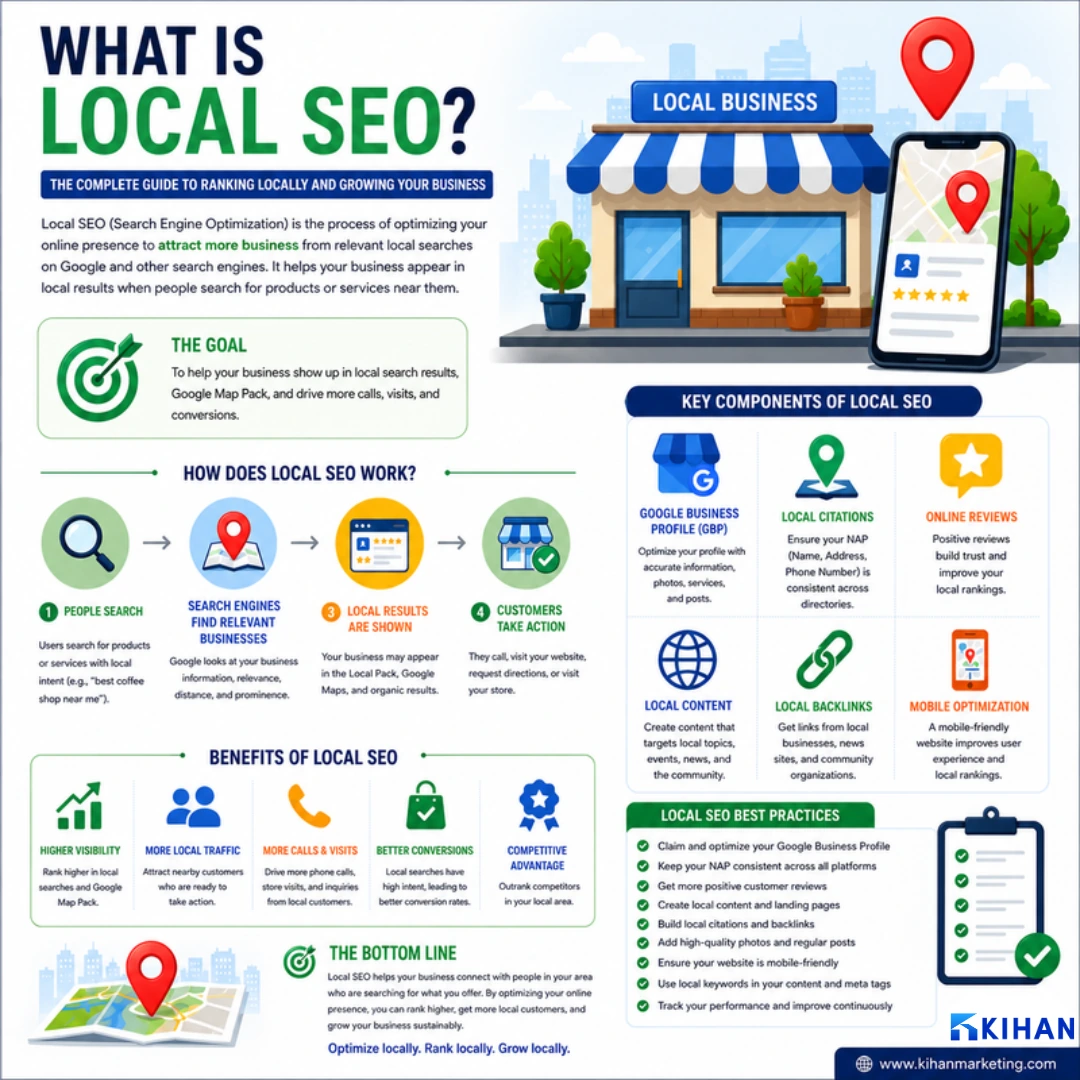
Local SEO is the practice of improving your online presence so customers find you when they search nearby, as in a “near me” search. It works mainly through your Google Business Profile, consistent business listings, reviews and website content about your area. Together these help you show up in the map pack. A large share of Google searches are people looking for a business nearby, not just information.
Local SEO helps nearby customers find you when they search for what you offer. Google ranks local results on three things: relevance, distance and prominence. You move them with a complete Google Business Profile, the same business details everywhere, steady reviews and a page for each service and area. Most local businesses need both the map pack and organic results.
What Local SEO Is
Local SEO is the work of making your business show up when nearby customers search for what you offer. It is about location. You aim to rank for “[service] near me” and “[service] [city],” not for the whole web. For any business that serves an area, it is the most important kind of SEO.
How Local SEO Works
Local SEO runs on a few signals. One is Google Business Profile optimization. The others are the same name, address and phone number across directories, a steady flow of reviews, and website pages about your services and locations. Google weighs relevance, proximity and prominence to decide who shows up for a local search.
The Map Pack and Why It Matters
The map pack is the top three local results, shown with a map. It gets most local clicks before people reach the regular listings. That makes it the single biggest prize in local SEO.
Who Needs Local SEO
Any business that serves a set area needs it: contractors, clinics, restaurants, med spas, law firms and home services. If customers come to you, or you go to them within a region, local SEO is how they find you. Online-only or nationwide sellers should focus on national SEO instead.
Putting it into practice? See local SEO for contractors and local SEO vs national SEO.
Related reading
- Google Maps SEO: 11 ways to improve your local business visibility
- How to Optimize Your Google Business Profile (2026 Guide)
- Local SEO for Contractors: How to Rank in the Google Map Pack
The Three Things Google Uses to Rank Local Results
Google publishes the factors behind local results, and there are only three. Almost everything a local SEO does is an attempt to move one of them.
Relevance. This is how well your profile and website match the search. It is the one you control most directly. It covers the primary category on your Google Business Profile, the services listed on it, and whether your website has a page about the thing being searched for.
Distance. This is how far you are from the searcher, or from the place named in the search. You cannot change it without changing where you are. That is why a business with no address in a city struggles to show up in that city’s map results, no matter how good its website is.
Prominence. This is how well known the business is. Reviews, mentions on other sites, links and the strength of your website all feed it. It is the slowest to move and the hardest for a competitor to copy.
Say you serve customers at their location and have no storefront. Distance will then cap what the map pack can do for you. The organic results below the map are where your work pays off. They are not capped by distance in the same way.
What a Local SEO Month Actually Involves
Local SEO is not one task. It is a small number of things done again and again, in roughly this order of impact.
Google Business Profile. Set the primary category correctly and list every service. Keep your hours accurate, add real photos often and answer questions. This is the highest leverage hour in local SEO, and it is free.
Location and service pages. Build one page per service, and one page per area you truly serve. Give each one something specific. A page that only swaps the city name will not hold a ranking.
Reviews. Build a set moment into your workflow where you ask for reviews, and make a habit of replying to every one. Reviews feed prominence, and they are what a searcher reads before calling.
Consistent business details. Keep your name, address and phone the same everywhere they appear. Old numbers and former addresses left on directory sites create confusion you do not want.
Measurement. Search Console shows which queries reach your website. The Google Business Profile performance tab shows what reaches your listing. They report on different things, so read them separately.
Where Local Results and Organic Results Differ
| Map pack | Organic results | |
|---|---|---|
| What ranks | Your Google Business Profile | Pages on your website |
| Positions available | Three, before a searcher taps to expand | Ten on the first page |
| Address requirement | Yes, a verified address or service area | No |
| Biggest lever | Profile completeness, reviews, proximity | Page depth, relevance, links |
| Where you read the data | Google Business Profile performance tab | Google Search Console |
Most local businesses need both. The map pack brings the phone calls. The organic result below it is what someone reads when they want to check you out before calling.
How to Check Your Own Local Visibility in Ten Minutes
- Search your main service plus your city, from a phone, not logged in. Look for two things: whether a map pack shows up at all, and whether you are in it. If a map pack shows up and you are not in it, the profile is the work. If no map pack shows up, this is an organic search, and your website is the work.
- Open your Google Business Profile performance tab. It shows the searches that brought up your listing. They are split into searches for your name and searches for what you do. If almost all of them are for your name, you are being found by people who already knew you existed.
- Open Search Console and sort queries by impressions. High impressions with almost no clicks usually means you rank on page three or four. You are shown but never chosen. Check the average position column before you assume the title is the problem.
- Look at your competitors’ review counts. The count matters here, not the star rating. It is the clearest sign of how much prominence you need to build to compete. You can see it without any tool.
How Long Local SEO Takes
Expect new pages to be indexed within days to weeks. Impressions usually first move within the first month or two. Meaningful ranking change tends to come around sixty to ninety days. Anyone promising first position in thirty days is describing something they cannot control.
Local SEOGoogle Business Profile work, location pages and multi-location setup for the map pack.FAQ: Local SEO Basics
What is local SEO?
It is the practice of improving your online presence so customers find you in local searches, such as a “near me” search. It works mainly through your Google Business Profile, reviews and local content.
How does local SEO work?
It works through an optimized Google Business Profile, consistent listings, reviews and content about your area. Together these help you rank in the map pack.
Why is local SEO important?
A large share of Google searches carry local intent. The map pack gets most of those clicks, so it drives most local leads.
Who needs local SEO?
Any business that serves a set area, such as contractors, clinics, restaurants, med spas and home services.
How long does local SEO take to work?
New and updated pages are usually indexed within days to a few weeks. Impressions tend to move first, then position, then clicks. Ninety days is a fair point to judge whether the direction is right. It is normal for results to keep building well past that.
Do I need a physical address to do local SEO?
You need one to show up in the map pack. It can be hidden if you serve customers at their location rather than yours. Without any verified address, map results are effectively closed to you. The work then shifts to organic rankings, which do not have the same requirement.
Can I do local SEO myself?
Yes, for the Google Business Profile work, and that is the highest return part. Filling every field, adding real photos, listing every service and replying to reviews cost nothing but attention. The parts that usually need help are the website structure and the content behind each service and area.
What is the difference between local SEO and a Google Business Profile?
The profile is one asset. Local SEO is the whole effort. It includes the profile, your website’s service and area pages, reviews, and how consistently your business details show up elsewhere online.
How much does local SEO cost?
It depends on how much work your profile and website need. The number of services and areas you cover, the state of your listings and reviews, and how crowded your local market is all move the cost. See the pricing page for how an engagement is scoped, or start with a free marketing audit.
What is a local SEO citation?
A citation is a listing of your business name, address and phone number on another site, such as a directory. In local SEO, these details should match everywhere they appear. Old numbers and former addresses left on directory sites create confusion, so cleaning them up is part of the routine work. Mentions on other sites also feed prominence.
Is local SEO worth it for a small business?
If your customers come from a set area, it usually is. The map pack gets most local clicks, and it brings the phone calls. The highest return part, your Google Business Profile, is free to work on. Online-only or nationwide sellers are better served by national SEO.
Jump back to a section