

TL;DR
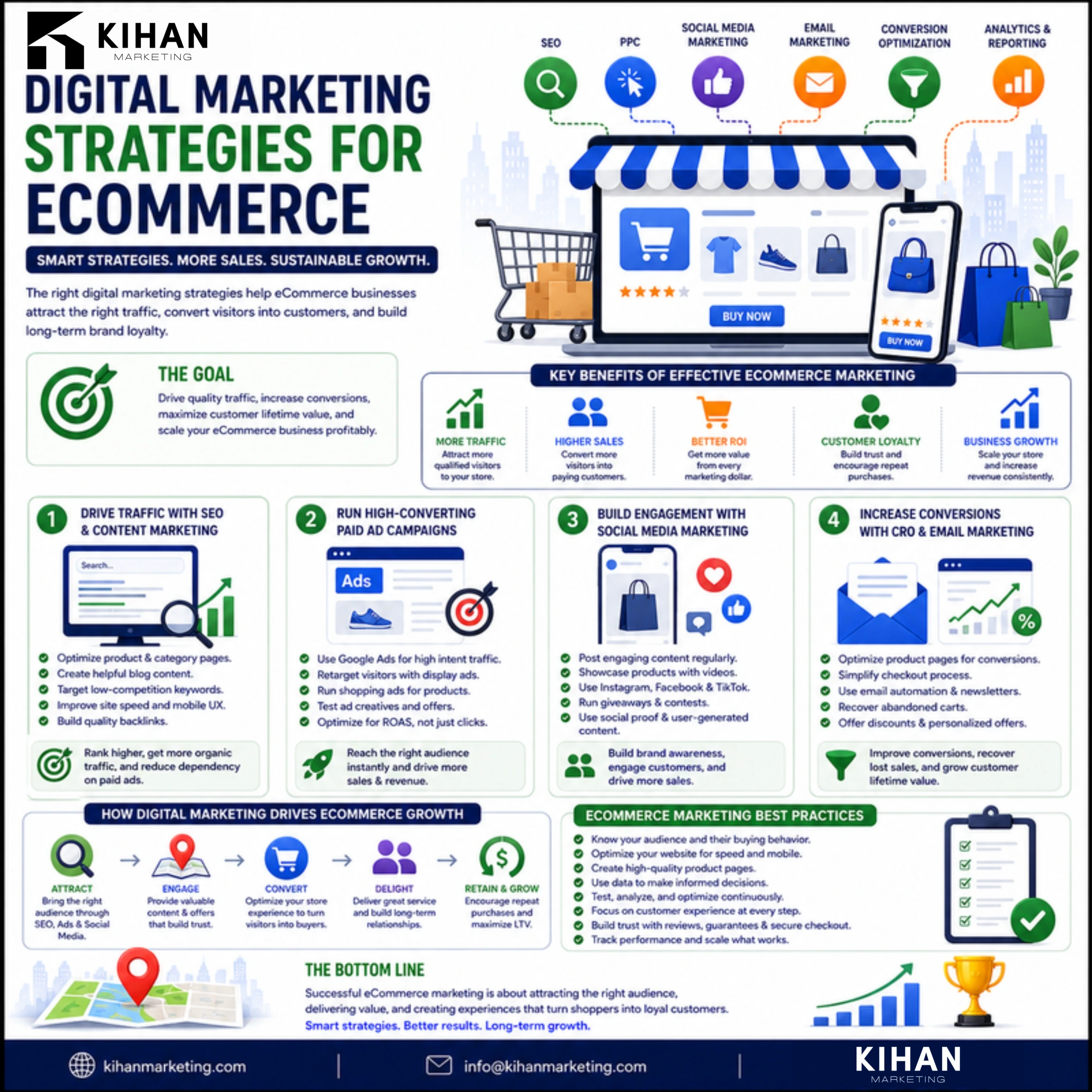
Digital marketing for ecommerce works best when four things run together: product-focused SEO, shopping and paid social ads, email and SMS lifecycle marketing, and conversion rate optimization. The mix sends qualified traffic to strong product pages. Email then turns first orders into repeat orders. An online store lives or dies on unit economics, the profit left on each order. So judge every channel against customer acquisition cost (what a buyer costs to win) and lifetime value (what they spend over time).
Pick channels by the kind of store you run, not by what other stores do. A slow, considered purchase is carried by search and email. A large, low-priced catalog runs on shopping ads and email flows. Visual impulse products sell through paid social. Then judge every channel on margin per order and repeat rate, never on revenue alone.
Product and Category SEO
Organic search is the cheapest traffic a store can get at scale. Shoppers often type long, exact phrases, and those people are close to buying. Tune your category and product pages to those phrases, and buyers arrive without a cost per click. Strong SEO also cuts your dependence on ad costs, which keep rising. That protects your margins as you grow.
Shopping and Paid Social Ads
Google Shopping puts your products in front of people who are ready to buy. Paid social on Meta and TikTok drives discovery for products that sell on looks. The winners share one habit: they watch return on ad spend closely. They test creative, audiences and offers. They cut anything that does not beat the target cost per new customer. Ads scale fast, but only when the unit economics work.

Email and SMS Lifecycle Marketing
The real profit in e-commerce is in repeat purchases. Email and SMS flows turn one-time buyers into loyal customers at almost no extra cost. The core flows are welcome, abandoned cart, post-purchase and win-back. A store that keeps its customers can afford to pay more to win them. That lifts every other channel. It is the highest-margin lever most stores underuse.
Conversion Optimization and Economics
Double your conversion rate and you double revenue without buying any more traffic. Work on product pages, checkout, page speed and trust signals pays back more than almost anything else in e-commerce. Tie it all back to the numbers that matter: customer acquisition cost and lifetime value. Then every channel decision becomes clear. A fast store with no friction is the foundation. See our approach to website development.
Related reading
- What Types of Digital Marketing Services Should You Invest In
- Cheap SEO vs Affordable SEO: What You Actually Get
- How to Get More Customers From Google Without Paying for Ads
Which Strategies Work Best, and for Which Kind of Store
There is no single answer, because the right channels depend on the kind of store you run.
A store that sells one considered product and a store with four hundred low-priced items look the same on the surface. They are not. The first is carried by search, comparison content and email nurture. The second runs on shopping ads, on-site search and lifecycle email. They share software, not economics.
| Type of store | What tends to carry it | What usually disappoints |
|---|---|---|
| Few products, considered purchase | Search, comparison content, email nurture | Broad paid social, because the decision is slow |
| Large catalog, low price point | Shopping ads, on-site search, lifecycle email | Long-form content on individual products |
| Visual and impulse driven | Paid social, creator content, retargeting | Category-page SEO against national retailers |
| Repeat consumable | Subscription mechanics, email and SMS, retention | Spending everything on acquisition |
Where Ecommerce SEO Actually Pays
A small store rarely wins broad category terms against national retailers. Three places are winnable.
Specific product variations
The exact size, material, fitting or compatibility someone searches for. Each phrase has tiny volume, and the buyer is nearly ready.
Comparison and alternative queries
People deciding between two products, or looking for an alternative to a brand. High intent, and rarely served well.
Use case and problem queries
What people search before they know the product category exists. This is where content earns customers, not just traffic.
The technical floor beneath all of it
A crawlable category structure, one URL per product, fast pages on mobile, and product structured data. None of it wins on its own. Without it, nothing else works.
The Numbers That Decide Whether Any of It Works
Ecommerce marketing is math more than it is creative. Four numbers decide whether a channel is worth running. Most stores track two of them.
Average order value
This sets the ceiling on what you can pay to win an order. Raise it, through bundles or thresholds, and every channel can afford more.
Contribution margin per order
Revenue minus product cost, shipping, payment fees and returns. Marketing is paid out of this, not out of revenue. Stores that forget the difference scale themselves into losses.
Repeat rate
If customers buy again, you can pay more than one order's margin to win them. If they do not, you cannot, whatever the industry average says.
Conversion rate by traffic source
One blended rate hides everything. Paid social and branded search convert at very different rates. Judge each on its own.
Email and SMS, Which Almost Every Store Underuses
An email list is the only audience a store owns outright. Platform reach changes, ad costs rise and search results shift. The list still works next year.
Four sequences cover most of the value. A welcome series that explains why you, rather than a competitor. An abandoned checkout reminder. A post-purchase sequence that asks for a review and suggests what pairs with the order. A reactivation message to people who have not bought in a while. Set them up once and they run without ongoing spend.
What This Costs
Ad spend goes straight to the platforms, on top of whatever the work itself costs. Fix the conversion basics before you add traffic. Paid traffic sent to a store that does not convert just loses money faster. Our pricing page explains what moves the size of the work and how to ask for a quote.
Free Marketing AuditWe read your Search Console and show which terms are close enough to page one to move.FAQ: E-commerce Marketing
What is the best marketing channel for e-commerce?
There is no single best. The winning mix is SEO plus shopping and social ads to win customers, and email and SMS to keep them. Judge all of it on ROAS, CAC and LTV: return on ad spend, the cost to win a customer, and what that customer spends over time.
Is SEO worth it for e-commerce?
Yes. Product and category SEO brings traffic that scales without a cost per click. It also cuts your dependence on rising ad costs.
How important is email marketing for online stores?
Critical. Repeat purchases drive e-commerce profit. Email and SMS flows convert at high margins and cost almost nothing per send.
Should e-commerce brands use paid social ads?
Yes, for discovery, and above all for visual products. Run them only while the return on ad spend beats your target cost per new customer.
Which digital marketing strategy works best for ecommerce?
It depends on the store. Search and email carry a store with few products and a considered purchase. Shopping ads and email flows carry a large, low-priced catalog. Paid social carries visual impulse products. The mistake is copying a strategy from a store with different economics.
Is SEO worth it for a small online store?
Yes, on the right terms. Broad category keywords against national retailers are usually not winnable. Specific product variations, comparison queries and use case content are. They attract buyers who are close to purchasing.
How much can an ecommerce brand afford to spend per order?
Up to your contribution margin per order. That is revenue minus product cost, shipping, payment fees and returns. If customers reliably buy again, you can spend more than one order's margin. If they do not, you cannot.
What is the most underused ecommerce channel?
Email and SMS. A welcome series, an abandoned checkout reminder, a post-purchase sequence and a reactivation message cover most of the value. They run without ongoing ad spend and reach an audience the store owns.
What is an ecommerce marketing strategy?
It is the mix of channels you run to bring buyers to your product pages and get them to buy again. For most stores that means product SEO, shopping and paid social ads, email and SMS flows, and conversion work on the site. Each channel is judged on what a customer costs to win and spends over time.
How do you start an ecommerce marketing strategy?
Start with the store, not the traffic. Fix product pages, checkout, page speed and trust signals first, because paid traffic sent to a store that does not convert loses money faster. Then pick the channels that fit your kind of store. Judge each one on margin per order, repeat rate and conversion rate by source.
What is an example of an ecommerce marketing strategy?
Take a store selling a repeat consumable. The plan leans on subscription mechanics, email and SMS, and retention, because the profit is in repeat purchases. Spending everything on new customers is what usually disappoints. The store tracks repeat rate and margin per order to see how much it can pay to win each new customer.