

TL;DR
B2B lead generation runs on two engines. Cold outreach buys you pipeline today at a flat cost per lead. Inbound compounds over 6 to 12 months, until leads arrive for near-zero marginal cost. Most companies overspend on cold and underinvest in inbound, because cold shows results in week one. The smart move is to fund both. Measure pipeline and closed revenue, not opens and clicks. Then shift budget toward inbound as it starts producing.
Cold outreach and inbound are teammates, not rivals. Use cold to book meetings now, and build inbound the whole time: search, content and a website that converts. Judge both by cost per qualified lead, booked meetings and closed revenue. Once inbound reliably closes deals, move budget toward it slowly, and never cut cold before inbound can carry the load.
What B2B Lead Generation Actually Means
B2B lead generation is the work of turning strangers into qualified conversations with people who can actually buy. Not impressions or followers, but conversations with a budget holder. Everything else is activity that may or may not lead there.
We split it into two engines, because they behave in very different ways:
- Outbound (cold) means you go find the buyer. Cold email, cold calls, paid ads and outbound LinkedIn all push your message to people who did not ask for it.
- Inbound means the buyer finds you. Search, content, referrals and a website that ranks pull in people who are already looking for a solution.
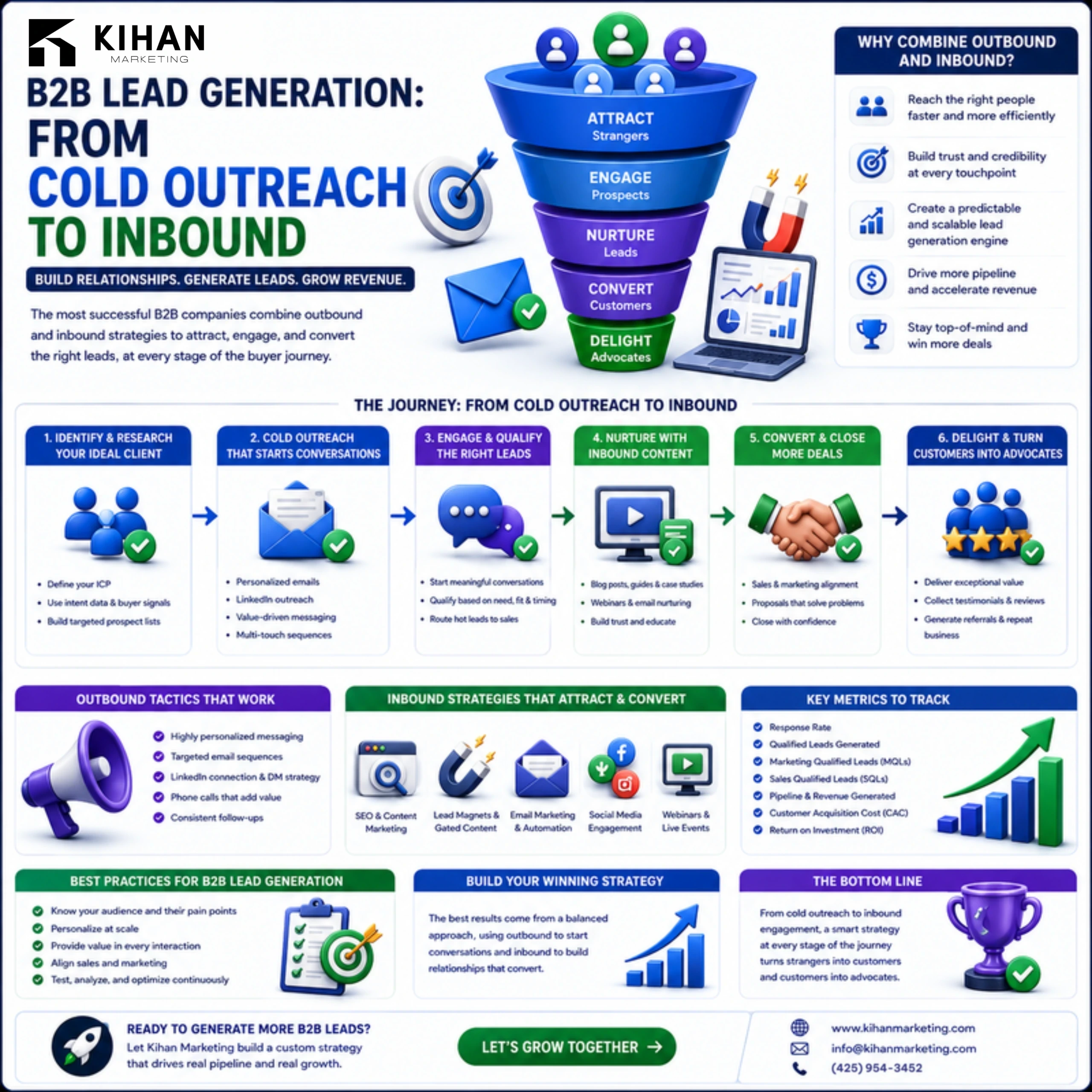
The mistake we see most often is treating these as rivals. They are teammates with different time horizons. Cold pays the bills this quarter. Inbound builds the asset that pays the bills for years. A serious B2B program funds both on purpose. Our lead generation work is built around that balance, not around whichever channel is trendy.
Cold Outreach: When It Works and When It Burns Cash
Cold outreach has one advantage no other channel can match: speed. You can launch a campaign Monday and book meetings by Friday. For a new company with no audience and no rankings, that speed is the whole point.
Cold works well when:
- Your target market is narrow and you can build an accurate list.
- Your average deal size justifies the labor, because cold is expensive per lead.
- You have a clear, specific offer, not “let’s hop on a call.”
Cold burns cash when:
- You blast a generic pitch to a giant list with no segments.
- You measure sends instead of replies and booked meetings.
- You expect it to scale forever. It does not: reply rates fall as volume climbs, and deliverability suffers.
A realistic cold email campaign might land a 1 to 3 percent positive reply rate. Booked meetings will be a fraction of that. That rate can be profitable for a large contract and a disaster for a small one. So run the math before you run the campaign.
Cold outreach is a faucet. It is useful, but it stops the moment you stop paying for it.
Inbound: The Slower Engine That Compounds
Inbound has the opposite shape. It produces almost nothing in month one, and it can take over your pipeline by month twelve. The reason is compounding. A blog post that ranks keeps pulling in leads every month at no extra cost. A cold email you sent last quarter is gone.
The core inbound channels for B2B:
- Search visibility, where pages that rank catch buyers in the middle of their research. Strong SEO is the backbone of lasting B2B lead generation.
- Content that answers real buying questions, which earns trust before the first call.
- A website built to convert, because traffic with no clear path to contact is just expensive flattery. We treat website development as a lead engine, not a brochure.
- Referrals and reputation, which inbound content quietly fuels by making you look like the obvious choice.
The catch is patience. Inbound usually takes 6 to 12 months to produce steady, predictable volume. Companies that quit at month three never see the payoff, and they decide “content does not work.” It works. They just turned off the engine before it warmed up.
Cold vs Inbound: A Head-to-Head Comparison
Neither one wins outright. They win in different columns.
|
Factor |
Cold outreach |
Inbound |
|
Time to first leads |
Days |
6 to 12 months |
|
Cost per lead over time |
Flat or rising |
Falls as content compounds |
|
Scales infinitely? |
No (deliverability and reply fatigue) |
Yes (rankings stack) |
|
Lead intent |
Low (you interrupted them) |
High (they came looking) |
|
Stops when you stop paying? |
Yes |
No (assets keep working) |
|
Best for |
Fast pipeline, new companies |
Durable pipeline, lower long-run cost |
Read the table honestly and the plan writes itself. Use cold to survive the first year. Build inbound the entire time, and let it take over as it matures.
How to Shift From Outbound to Inbound Without Going Dark
The danger in switching is cutting cold too early. If inbound cannot carry the load yet, your pipeline collapses. So we never recommend flipping a switch. We recommend a glide path: a slow, planned shift.
- Keep cold running at full strength while inbound is still young. Do not touch the channel that pays your bills.
- Reinvest a fixed share of cold revenue into inbound every month. The asset grows without starving today’s pipeline.
- Track when inbound leads start closing. Once inbound reliably brings in a meaningful share of booked revenue, start trimming cold spend.
- Rebalance toward the cheaper channel. As inbound’s cost per lead drops below cold’s, the budget should follow.
This is a 12 to 18 month shift, not a one-quarter project. Done right, you never go dark. You end up with a pipeline that costs less and converts better.
The Metrics That Matter and the Vanity Ones to Ignore
We do not count open rates as a win. We do not celebrate traffic that never becomes a conversation. Vanity metrics make agencies look busy and make clients feel good, while the bank balance stays the same.
Ignore these as success metrics:
- Email open rates (privacy features break them anyway)
- Impressions and reach
- Social followers
- Raw website traffic with no conversion context
Track these instead:
- Cost per qualified lead, by channel
- Booked meetings and pipeline created
- Lead-to-customer conversion rate
- Closed revenue and customer acquisition cost
- Payback period (how long until a customer covers their acquisition cost)
If a B2B lead generation report does not connect spend to revenue, it is not a report. It is a highlight reel. Want a clear read on which channels work before you commit budget? Start with a free marketing audit.
A Realistic 90-Day B2B Lead Generation Plan
You cannot build a 12-month asset in 90 days. But you can lay every piece of the foundation.
Days 1 to 30: Stabilize cash flow.
- Launch or tune a tightly segmented cold campaign with a specific offer.
- Fix the website’s path to contact, so existing traffic stops leaking.
- Set up proper tracking, so every lead has a known source.
Days 31 to 60: Plant the inbound seeds.
- Publish content aimed at the exact questions your buyers search.
- Improve the pages that already get traffic but do not convert.
- Start building search authority with on-page and technical SEO.
Days 61 to 90: Measure and rebalance.
- Compare cost per qualified lead across channels.
- Double down on whatever is producing booked meetings.
- Set the rule that reinvests cold revenue into inbound from now on.
By day 90 you will not have a mature inbound engine. You will have a working faucet, a growing asset, and the data to know where the next dollar should go. Want to know what that program would look like for your business? The pricing page explains what shapes the scope.
SEO and AI SearchLocal, technical, schema and AI search work that helps buyers find you.FAQ: B2B Lead Generation
How long does B2B lead generation take to work?
Cold outreach can produce booked meetings within days. Inbound usually takes 6 to 12 months to deliver predictable volume. A healthy program uses cold for speed while it builds inbound to last.
Is cold email dead for B2B?
No, but spray-and-pray cold email is. Outreach to a tight, well-segmented list with a specific offer still books meetings. Generic blasts to giant lists waste money and hurt deliverability.
What is a good cost per lead in B2B?
It depends on deal size. The same lead cost can be great for a large contract and terrible for a small one. Always measure cost per lead against average deal value and close rate, never on its own.
Should a small company start with cold or inbound?
Usually both, weighted toward cold first. New companies need pipeline now, and cold provides it. Meanwhile inbound builds in the background to lower acquisition costs over the long run.
Which b2b lead generation metric matters most?
Closed revenue per dollar spent, with payback period close behind. Opens, clicks and impressions are diagnostics at best and distractions at worst.
What does B2B lead generation cost?
There is no single figure, because the cost follows your mix of channels. It moves with how narrow your list is and how much labor cold outreach takes. It also moves with how much content inbound needs, and whether your website’s path to contact must be fixed first. For Kihan Marketing work, the pricing page lists what sets the scope.
Should you outsource B2B lead generation?
It can work, as long as the partner is judged on the right numbers. Ask how they would split effort between cold outreach and inbound. Ask whether they track booked meetings, pipeline and closed revenue, or only opens and impressions. A partner who cannot connect spend to revenue is handing you a highlight reel.
Is LinkedIn good for B2B lead generation?

It can be, if you use it the right way. Outbound LinkedIn messages are cold outreach, so the cold rules apply. They work when your market is narrow, your list is accurate and your offer is specific. Measure replies and booked meetings, not messages sent. Organic LinkedIn is a separate topic, covered in LinkedIn Marketing for B2B.
The companies that win at B2B lead generation are not the ones with the cleverest cold script or the most blog posts. They fund both engines, measure revenue instead of vanity, and stay patient enough to let inbound compound. If you want a partner who reports on pipeline rather than impressions, see how we approach lead generation and SEO.
Related reading
- Cold Email Sequences That Get Replies in 2026
- Best Lead Generation Strategies for Small Businesses (Ranked)
- How Service Businesses Get More Leads From Google in 2026
Traffic only matters if it turns into inquiries. That is the whole point of our lead generation work.