

TL;DR
A cold email sequence that gets replies in 2026 is short: 3 to 5 emails, spaced 2 to 4 days apart. Build it around one specific problem the reader has, not around your pitch. Keep the first email under 120 words, make it highly relevant, and ask one easy question. On a clean, well-targeted list, expect a 1 to 5 percent reply rate. Deliverability, not clever copy, is what makes or breaks the whole thing.
Fix the list and the sending setup before you polish the copy. Send 3 to 5 short emails over two to three weeks. Each one adds a new angle and makes one easy ask. Judge the sequence by replies and booked calls, not opens. On a clean list, a 1 to 5 percent reply rate is healthy.
What a Cold Email Sequence Actually Is
A cold email sequence is a planned series of messages to someone who has never heard from you. Its one job is to earn a reply that starts a real conversation. It is not a newsletter or a drip campaign to warm leads. And it is definitely not a place to dump your feature list. The whole sequence aims at a single human response. After that, a person takes over, not an automation.
We will be blunt about something the inbox blasters will not tell you. Most cold email is bad, and most of it deserves to be ignored. The version that works in 2026 looks almost nothing like the spray-and-pray templates of five years ago. It is targeted, restrained and written for one reader. Done right, a cold email sequence is one of the highest-return channels in outbound. That is why it sits beside SEO and paid ads as a core part of any serious lead generation program.
Why Most Cold Email Sequences Get Ignored
If your replies are flat, the copy is rarely the first problem. Here is what actually kills a cold email sequence, roughly in order of impact:
- Bad targeting. A perfect email to the wrong person gets nothing. Most failed campaigns are list problems dressed up as copy problems.
- It is about you. An opener like “We are a full-service agency that…” tells the reader you did not research them. It also warns them you are about to waste their time.
- It is too long. Nobody reads a 300-word cold pitch on a phone between meetings.
- No clear, easy ask. “Let me know if you would like to schedule a 30-minute discovery call” adds friction. A yes/no question does not.
- Deliverability is broken. If your email lands in spam, the copy does not matter. We cover this below, because in 2026 it is what makes the difference.
Notice that four of the five have nothing to do with how clever your writing is. That is the part most people get backwards. They polish subject lines while their domain reputation quietly sinks.
The Anatomy of a Sequence That Gets Replies
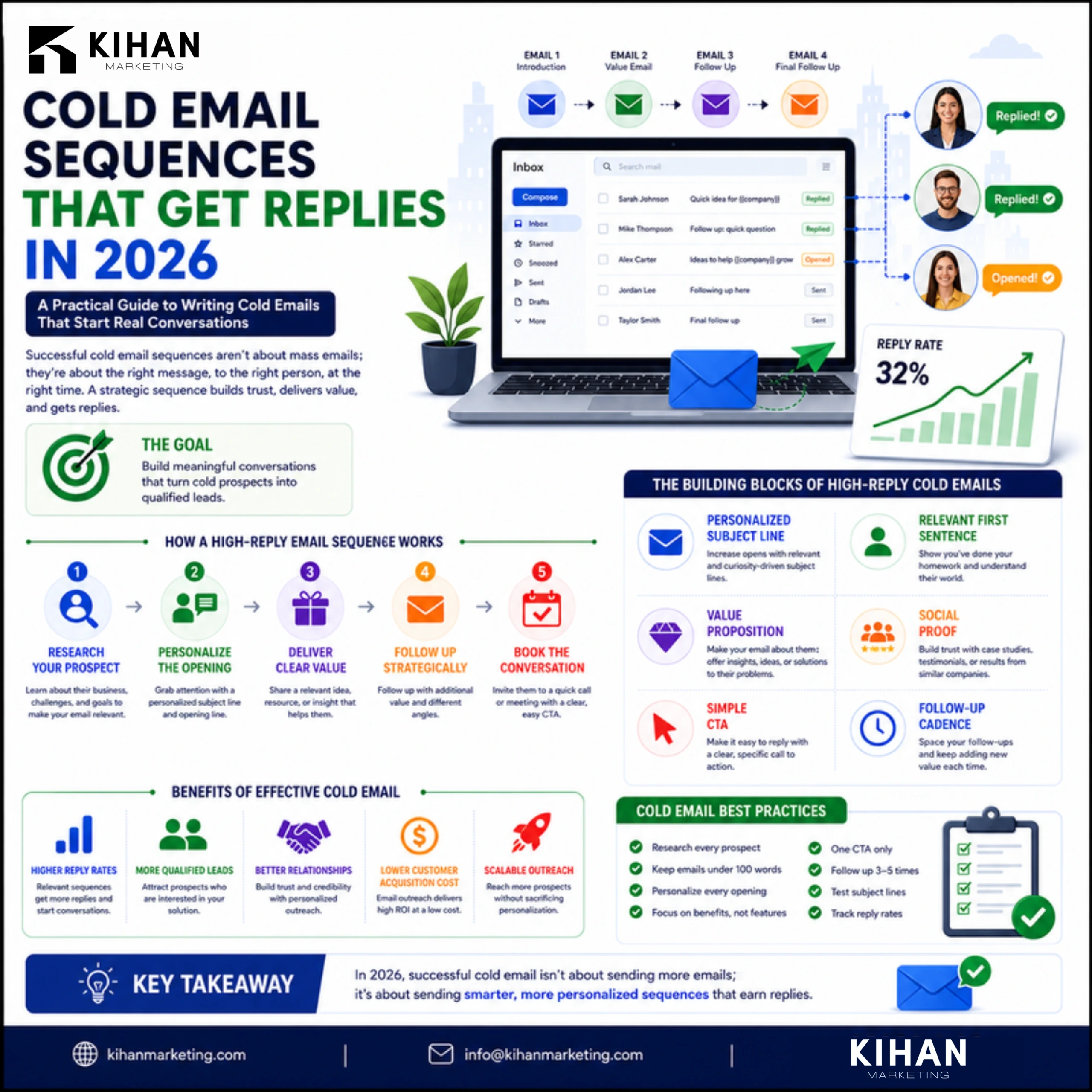
A modern cold email sequence is short and patient. It runs three to five touches over two to three weeks. Each one adds a small new angle, and then the sequence ends with a clean exit. Here is a cadence that holds up across industries, from home services to professional firms.
Day | Purpose | Length | Core Ask | |
1 | Day 1 | Relevant hook plus one problem | Under 120 words | Single yes/no question |
2 | Day 3 | Add proof or a specific result | Under 90 words | Soft nudge, restate the question |
3 | Day 7 | New angle or useful insight | Under 90 words | Offer something of value |
4 | Day 12 | Pattern interrupt, short and human | Under 60 words | “Wrong person?” redirect |
5 | Day 18 | Polite breakup | Under 50 words | Permission to close the loop |
Two rules govern the whole table. First, every email should make sense on its own, because the reader may open only one. Second, each follow-up adds something new. “Just bumping this up” is not a reason to email a stranger again. Relevance beats volume every time.
Say a roofing or HVAC company runs outbound to property managers. Each touch in its sequence should come at the manager from a new angle. It should not repeat the same offer, only louder.
Writing the First Email
The first email carries most of the weight, so treat it as the only one you get. Build it in four quick beats.
1. A subject line that reads like a coworker wrote it
Keep it lowercase, specific and free of hype. “question about your Lynnwood location” beats “Unlock 3X Growth Today” every single time. Avoid anything that smells like a promotion, because spam filters and people both flag it.
2. A first line that proves you did your homework
Mention something true and specific about them: a recent hire, a service area, a review trend, a new location. This one sentence is what sets you apart from the 40 other pitches in their inbox. If you cannot write a genuine, specific opener, your list is too broad.
3. One problem, framed as theirs
Name a single problem you can credibly solve. Put it in their words, not yours. Give them one problem, not three. Within five seconds, the reader should think, “yes, that is annoying.”
4. One low-friction question
End with a question they can answer in one word. For example: “Worth a quick look?” or “Are you the right person for this?” A yes opens the door. A meeting request slams it shut.
Keep the whole email under 120 words. If it does not fit on a phone screen without scrolling, cut it.
Follow-Ups: How Many, How Often, What to Say
Most replies actually come from the follow-ups, often emails three and four, not the opener. The skill is in restraint.
- How many: Send three to four follow-ups after the first email. Past five touches in total, you are annoying people. You also risk spam complaints that hurt deliverability.
- How often: Every two to four business days at first, stretching to a week as the sequence ages. Do not email a stranger daily.
- What to say: Each touch needs a fresh reason to exist: a result, an insight or a relevant question. The “breakup” email, where you offer to close the loop, is often the top performer. It works because it triggers loss aversion, the urge people feel to avoid losing something.
One thing we never do is fake a reply on our own thread with “re:” to create urgency. It erodes trust the moment the prospect notices, and they always notice. Outbound that relies on tricks does not grow into a real pipeline. That is the same reason we steer clients away from vanity tactics on every channel: paid, SEO and email alike.
Deliverability in 2026: The Rules Changed
This is the part that decides whether your cold email sequence works, and the part most guides bury at the bottom. In 2024, major providers began enforcing stricter rules for senders, and the bar has only risen since. Ignore the technical side and your well-written sequence lands in spam, where it reaches no one.
The non-negotiables in 2026:
- Authenticate everything. Set up SPF, DKIM and DMARC properly on your sending domain. These records prove to inbox providers that the mail really comes from you. This is table stakes, not optional.
- Use a separate sending domain. Send cold outreach from a variant of your domain, not your main company domain. That way a deliverability hit never touches your real email.
- Warm up new inboxes. Raise the volume slowly over weeks. A brand-new inbox blasting 500 emails a day is a spam folder waiting to happen.
- Keep volume sane per inbox. Spread sends across several inboxes and keep each one to a modest daily cap.
- Watch your complaint and bounce rates. Verify every list before sending. A high bounce rate is a fast track to a blacklist.
You can write the best cold email sequence in your market, but none of it matters if your domain reputation is in the gutter. This is plain, unglamorous setup work. It is also exactly where most DIY campaigns quietly fail.
Metrics That Actually Matter
We are allergic to vanity metrics, and cold email is full of them. Open rates in particular became close to meaningless once privacy features began loading images on their own and inflating the number. Stop optimizing for opens.
Track the numbers tied to revenue instead:
- Reply rate: 1 to 5 percent on a clean, targeted list is healthy. Below 1 percent usually means a targeting problem.
- Positive reply rate: Of those replies, how many show interest rather than say “remove me.” This is the real signal.
- Booked calls: The number that pays the bills.
- Bounce rate: Keep it under roughly 3 percent, or pause and clean the list.
- Cost per booked meeting: The only efficiency number worth reporting to a business owner.
If a “successful” campaign earns a great open rate and zero booked calls, it failed. Full stop.
Free Marketing AuditWe read your Search Console and show which rankings are close enough to page one to move.FAQ: Cold Email Sequences
How many emails should a cold email sequence have?
Three to five in total: the first email plus two to four follow-ups over about two to three weeks. Past five, you start to draw spam complaints. Those damage deliverability faster than the extra touches help.
What is a good reply rate for cold email in 2026?
On a clean, well-targeted list, 1 to 5 percent is a realistic range. If you are below 1 percent, fix your targeting and deliverability before you touch the copy. Those are almost always the cause.
Is cold email even legal?
B2B cold email is legal in the US under CAN-SPAM when you tell the truth, identify yourself and offer an easy opt-out. Rules differ by country, so check requirements such as GDPR before you email prospects abroad.
Why are my cold emails going to spam?
It is almost always a deliverability issue. The usual causes are missing authentication, an inbox that sends too fast before it is warmed up, too much volume, or a list full of bad addresses. Fix the technical setup before you blame your writing.
Should I personalize every single email?
Personalize the first line of the first email, yes, with something specific and true. You do not need to hand-write all five. But generic openers sent to broad lists are the fastest way to get ignored.
What subject line should a cold email follow-up use?
Use the same rules as the first email: lowercase, specific and free of hype, as if a coworker wrote it. Anything that reads like a promotion gets flagged by spam filters and by people. Never fake a “re:” to make it look like an ongoing thread. Prospects notice, and it costs you their trust.
Can a cold email sequence be fully automated?
The sending can be automated, but not the whole job. The first line of the first email still needs something specific and true about the reader. And once someone replies, a person should take over, not an automation. The sequence exists to earn that one human conversation, so automating the reply defeats its purpose.
Should I use a cold email follow-up template?
A template can set the structure: the timing, length and ask for each email, as in the table above. It cannot supply the substance. Each follow-up still needs a fresh reason to exist, such as a result, an insight or a relevant question. A follow-up that only says “just bumping this up” gives nobody a reason to reply.
A cold email sequence is not a magic trick. It is targeting, restraint and boring deliverability discipline working together. Get those right, and a few short, specific emails will out-earn a thousand clever ones. If outbound is one piece of a bigger growth push, see how we tie it to the rest of the funnel on our lead generation page. Or grab a free marketing audit to find the other channels worth your budget.
Related reading