
LinkedIn Marketing for B2B: Organic Growth Tactics

Ask AI to Summarize




TL;DR
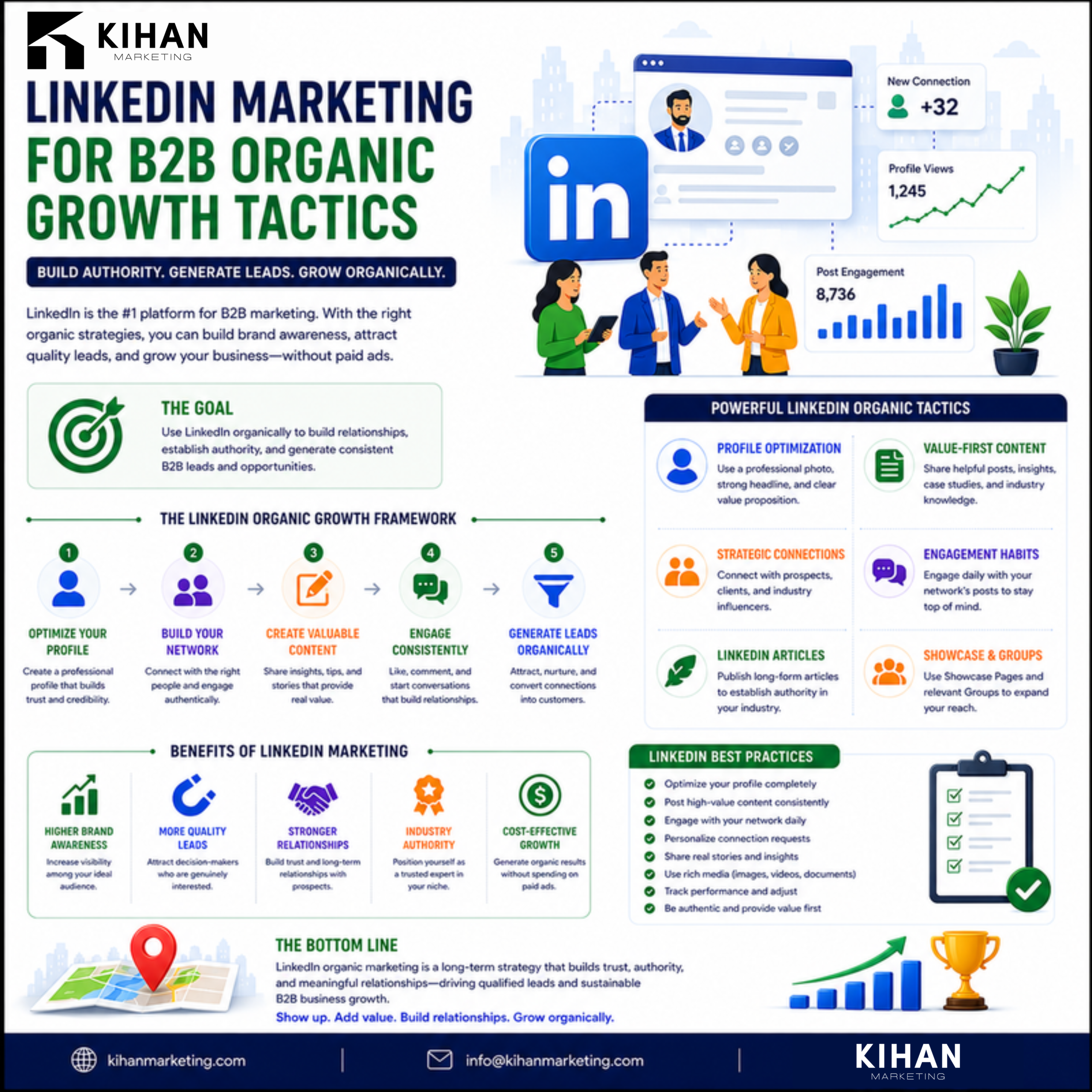
Organic LinkedIn marketing for B2B works when you treat it as a pipeline channel, not a popularity contest. The tactics that actually move revenue: optimize personal profiles over the company page, post 3 to 5 times a week with specific insight instead of motivational fluff, comment strategically on prospects’ posts, and run light, human outreach. Expect 60 to 90 days before meetings show up. Likes do not pay invoices. Track profile views, connection-to-conversation rate, and booked calls instead.
Why Most B2B LinkedIn Advice Wastes Your Time
Most LinkedIn advice is written to get the advice-giver more likes, not to get you more clients. That is the core problem. The platform rewards engagement, so the loudest voices optimize for engagement, and then they sell that same playbook to businesses that need revenue, not applause.
We will say it plainly: a post with 800 likes and zero qualified conversations is a failure. Effective linkedin marketing b2b is measured in booked calls and pipeline, not reactions. If your LinkedIn activity is not producing conversations with people who could actually buy from you, it does not matter how many notifications you get.
The good news is that the bar for standing out is low precisely because so much content is filler. When everyone else posts recycled motivation and “agree?” bait, a few genuinely useful, specific posts from a real expert cut through. That is the opening organic LinkedIn gives a focused B2B business, and it is the same discipline behind any results-driven lead generation program.
Profiles Beat Pages: Where to Put Your Effort
Here is a contrarian truth: your company page is not where deals start. People buy from people. On LinkedIn, personal profiles get far more reach and trust than branded company pages, so that is where the effort belongs.
Treat the profile of your founder or top salesperson as a landing page. Optimize it in this order:
- Headline: state who you help and the outcome you deliver, not your job title. “I help HVAC companies book more installs” beats “Owner at Acme.”
- Banner and photo: look like a real, credible human, not a stock template.
- About section: lead with the prospect’s problem, then your approach, then a soft call to connect.
- Featured section: link to a case study, a useful resource, or a clear next step.
The company page still matters as a credibility check, since prospects glance at it after a personal post catches their eye. Keep it current and consistent with your website, the same way a clean, fast site supports every other channel. If your site undercuts that first impression, our website development team handles that gap, and your broader SEO presence backs up the trust a profile starts.
A Content Cadence That Actually Generates Replies
Posting frequency without substance is just noise. The cadence that works for linkedin marketing b2b is 3 to 5 posts a week, each carrying one concrete idea a prospect can use. Consistency teaches the algorithm and your audience to expect you; specificity is what earns the reply.
Rotate through post types so you are not repeating yourself:
- Insight posts: a non-obvious lesson from your work, with a real number or example.
- Teardown posts: a common mistake in your industry and the fix, written without jargon.
- Proof posts: a result you produced, framed around the client’s problem and outcome.
- Point-of-view posts: a clear stance on a debate in your field that invites discussion.
Two rules keep this on track. First, write to one specific reader, the decision-maker you want as a client, not to “everyone.” Second, end with a question or a low-friction next step so the post opens a conversation rather than closing one. The goal of every post is a comment or a message, because that is where a relationship and eventually a deal begins.
Engagement and Outreach Without Being a Pest
Posting is only half of organic LinkedIn. The other half is showing up in the right comment sections and DMs without turning into the person everyone mutes.
Spend 15 to 20 minutes a day commenting on posts from your target prospects and their networks. Add a real thought, not “Great post.” Useful comments on a prospect’s content put you on their radar far more naturally than a cold pitch. Over a few weeks, that familiarity makes a connection request feel expected rather than random.
When you do reach out, keep it human and short:
- Connect with a one-line note that references their actual work.
- Do not pitch in the next message.
- Open a real conversation about their situation before mentioning what you do.
- Suggest a call only once there is a genuine reason to.
The fastest way to kill linkedin marketing b2b results is the automated pitch sequence that fires the second someone accepts. We do not run those, because they burn the trust the whole channel depends on. Slower, human outreach books fewer but far better meetings, the same principle that makes our roofing marketing and other vertical programs convert.
Organic vs Paid: When Each Earns Its Keep
Organic and paid LinkedIn are not rivals; they solve different problems. The table below shows when each pulls its weight.
|
Factor |
Organic LinkedIn |
Paid LinkedIn ads |
|
Upfront cost |
Time, not ad spend |
Higher media budget |
|
Speed to results |
60 to 90 days |
Days to weeks |
|
Trust built |
High, founder-led |
Lower, ad-driven |
|
Best for |
Relationships, authority |
Scale, precise targeting |
|
Ongoing effort |
Daily, consistent |
Budget and creative mgmt |
|
Cost per lead |
Lower over time |
Higher, predictable |
For most small and mid-size B2B firms, organic is the right starting point because it compounds and does not require a large budget. Paid makes sense once you have a proven offer and want to scale reach faster. A sensible plan often layers them, and how you split budget is exactly the kind of tradeoff we map out in our pricing conversations.
The Metrics That Matter (and the Ones to Ignore)
Vanity metrics are the enemy of good decisions. Likes, follower counts, and impressions feel good and tell you almost nothing about revenue. Track the numbers that connect to pipeline instead.
The metrics worth watching:
- Profile views from your target audience. Rising views mean your content is reaching the right people.
- Connection-to-conversation rate. Of new connections, how many turn into a real exchange?
- Conversations-to-meetings rate. How many exchanges become booked calls?
- Booked calls and pipeline value. The only numbers that pay invoices.
If a tactic boosts likes but not conversations, drop it. If a quieter post style produces more DMs, do more of that. This is the same discipline we apply across channels, from Google Business Profile optimization to search. The point of linkedin marketing b2b is not to be seen; it is to be hired.
FAQ: LinkedIn Marketing for B2B
Plan on 60 to 90 days of consistent posting and engagement before meetings show up reliably. Organic builds trust over time, so the early weeks feel slow before momentum compounds.
Personal profiles win. They get more reach and far more trust than company pages. Use the company page for credibility, but put your posting effort behind a real person.
Three to five times a week is the sweet spot, as long as each post carries one specific, useful idea. Frequency without substance just trains people to scroll past you.
No. Most small and mid-size B2B firms get strong results from organic alone. Ads help you scale reach once you have a proven offer, but they are not required to start.
Chasing vanity metrics and pitching too soon. Likes do not equal pipeline, and automated cold pitches burn trust. Lead with useful content and human conversations instead.
Done right, organic LinkedIn is one of the highest-ROI channels a B2B business has, because it trades time and consistency for relationships that convert. If you want a channel mix built around booked calls rather than likes, start with a free SEO audit to see where LinkedIn fits alongside search, or review our lead generation approach to see how the pieces work together.
Related reading