



TL;DR
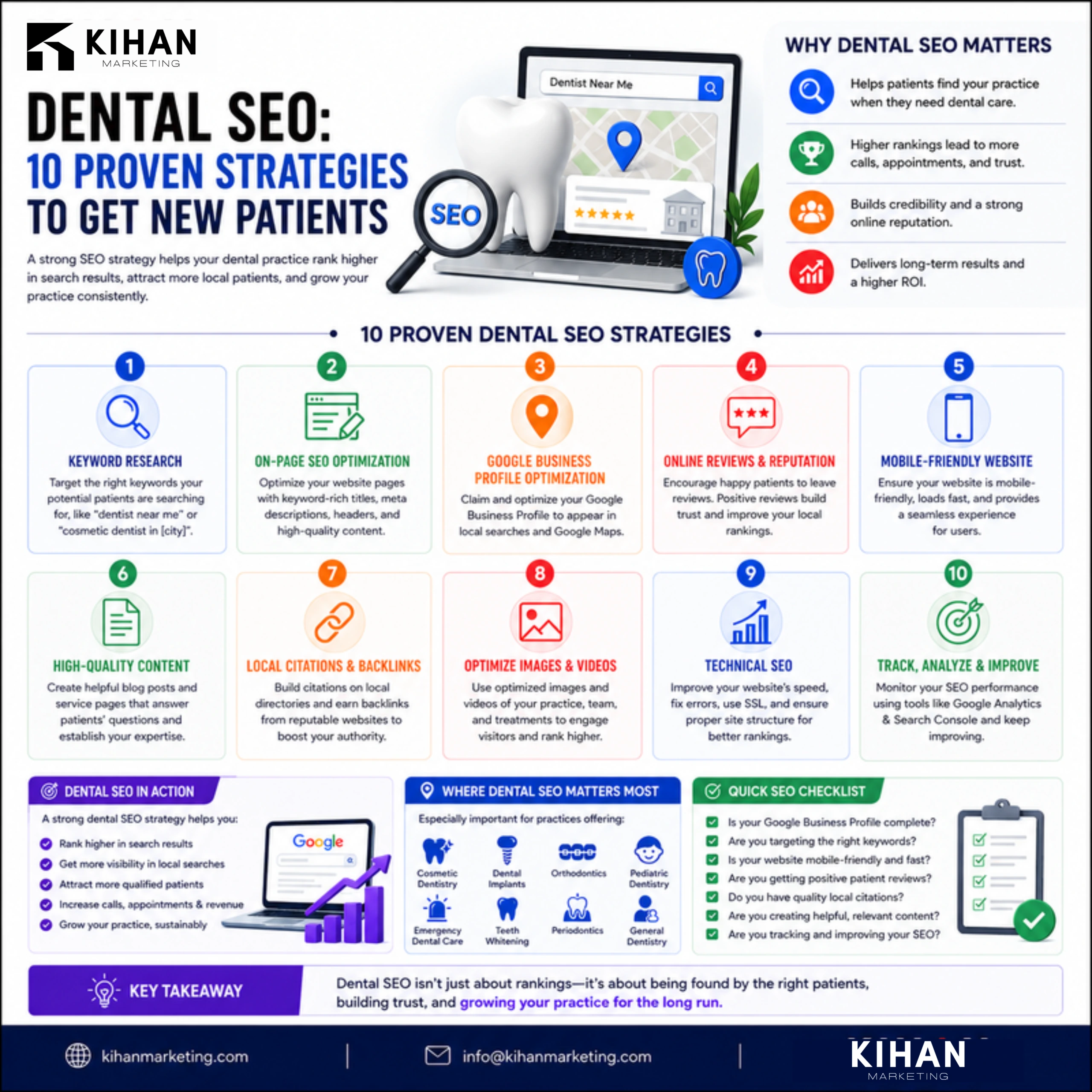
Dental SEO helps a practice get new patients from Google. It does that by ranking for searches like “dentist near me” and “[city] dental implants.” Four things win: an optimized Google Business Profile, a fast mobile site with online booking, location and service pages, and a steady flow of reviews. Local search drives most new-patient calls before a patient ever sees your website.
Most new patients find a dentist through local search, so the map pack matters most. Keep your Google Business Profile complete and your reviews recent. Give each treatment, location and provider its own page. SEO keeps bringing in patients after the work is done, while ads stop the day you stop paying.
Why Dental SEO Beats Paid Ads Long-Term
Paid ads stop the moment you stop paying. SEO is an asset that keeps bringing in patients after the work is done. For a practice, that means a lower cost per new patient over time. It also means your reach keeps growing for the high-value treatments you want more of. Ads have their place when you need patients right away. But ranking in the unpaid results for “dentist near me” is what builds a steady flow of new patients you can plan around.
Google Business Profile for Dentists

Most new-patient searches are local. The map pack, the top three results shown with a map, gets most of those clicks. You win it with complete Google Business Profile optimization. That means the right category, real photos of your office and team, full service lists, correct hours and a steady stream of recent reviews. A well-kept profile regularly outranks bigger practices that treat their listing as an afterthought.
Service and Location Pages
Patients search for specific treatments and places. They type “dental implants [city],” “Invisalign near me” or “emergency dentist [city].” So build a useful page for each high-value service and each area you serve. That tells Google you are the local authority. It also catches searches from people who are ready to book. Thin, templated pages will not do the job. Depth and detail win.
Reviews and Trust for Dental Practices
Healthcare is a high-trust decision, so reviews and proof of credibility do real work. A steady flow of recent, detailed reviews lifts your local rankings. It also gives a new patient more confidence in you. Show your providers’ credentials, and answer common questions clearly. These are E-E-A-T signals, short for experience, expertise, authority and trust. They also make your content more likely to show up in AI search and to turn into booked appointments.
Related reading
The Kinds of Searches Dental Patients Actually Make
Patients do not all make the same search, and they do not all want the same page. Most practices build one services page and miss three of these four groups.
- Emergency: A broken tooth, severe pain, a knocked-out tooth, or a problem on a weekend or after hours. These people choose fast and rarely compare. They need a page that says whether you can see them today and how to reach you right now. A paragraph about your philosophy of care will not help them.
- Procedure: Implants, Invisalign, veneers, root canals and wisdom teeth. These are high-value choices that people think over for a long time, and they read several practices’ sites first. Each one deserves a real page. It should cover what is involved, how long it takes and what it costs.
- Insurance and payment: Whether you take their plan, whether you offer payment plans, and what a visit costs without insurance. Practices often leave this off the site entirely. It is one of the most common reasons someone picks a different practice.
- Near me and new patient: “Dentist near me,” “new patient specials” and “accepting new patients.” Your Google Business Profile answers these more than your website does, and the map pack decides them.
How to Structure Treatment Pages
One page per treatment beats a single services page that lists everything. Each page can then answer the exact question a searcher typed.
- Name the treatment the way patients name it: People search for what they call it, not its clinical name. Cover both, and put the patient’s phrase in the heading.
- Answer the three questions everyone asks: What is involved, how long it takes and what it costs. A page that answers all three beats one that answers none and asks for a call.
- Show your own work and your own team: Stock photos are invisible to a patient choosing between two practices. Photos of your actual rooms and providers are not.
- Say who it is not for: Being honest about when a treatment is not the right choice builds more trust than any testimonial. It also cuts down on consultations that were never going to book.
- Make booking obvious from anywhere on the page: Keep the phone number and booking link in view, so no one has to scroll back to the top. That goes for phones as well as desktops.
Practices With Several Providers or Locations
Give each location its own Google Business Profile. Verify each one at its own address, with its own hours and its own reviews.
Picture a practice with two offices that share one Google listing. That setup costs the practice the map pack in one of the two areas. One office shows up for local searches, and the other one misses out.
On the website, give each location its own page with its address, hours, parking notes and team. Give each provider a real page too. Patients search for dentists by name more often than practices expect. A provider page is usually the easiest page in the whole set to rank.
What to Track
These five signals show whether your dental SEO is bringing in patients, and where each one lives.
| Signal | Where | What it tells you |
|---|---|---|
| Calls and direction requests | Google Business Profile performance tab | The map pack is working, or it is not |
| Queries reaching the site | Google Search Console | Whether treatment pages are being found for treatment searches |
| New patient forms | Your website analytics | Only countable if the submission is set up as a conversion |
| Review count and recency | Your profile | The single clearest signal to a patient comparing two practices |
| Which treatments the new patients booked | Your practice software | Tells you which pages to build next |
What Dental SEO Costs and How Long It Takes
Expect new pages to be indexed in days to weeks. Impressions tend to move in the first month or two. Ranking change becomes meaningful around sixty to ninety days. The map pack largely decides emergency and near me searches. So work on your profile tends to show results sooner than work on your pages.
Dental SEOHow we handle emergency, routine and treatment searches for dental practices, from treatment pages to the map pack.FAQ: Dental SEO
How do dentists get more patients from Google?
They win the local map pack with an optimized Google Business Profile. They get their service and location pages to rank. And they collect reviews on a steady basis.
Is SEO worth it for dental practices?
Yes. It builds a flow of new patients that keeps growing, at a lower cost per patient than paid ads over time.
How much does dental SEO cost?
It depends on your market and how much competition you face. Over time, owned channels like SEO lower your cost per new patient as your rankings build. Our pricing page explains what shapes the scope of the work.
How long does dental SEO take to work?
Google Business Profile improvements can show within weeks. Organic rankings usually build over 4 to 8 months.
How many pages does a dental practice website need?
One per treatment you actually want more of, one per location and one per provider, plus the standard pages. That is usually more than a practice starts with. It is far fewer than a page generator would produce.
Do dental practices need Google Ads as well as SEO?
Ads make sense when you need chairs filled now, or when you launch a high-value treatment. SEO is what makes the ads less needed later. If the budget only covers one, decide by how soon you need the patients.
What is the most common dental SEO mistake?
One page that lists every treatment. It cannot rank for any specific treatment search. It says two sentences about each one instead of answering the question someone actually typed.
Should we publish treatment prices?
Where you can, yes. Cost is one of the three things every patient wants to know. A page that answers it gets chosen over one that makes people call to find out. A range, with what it depends on, is enough.
How do you choose a dental SEO company?
Choose one whose plan starts with your Google Business Profile, your reviews and a page for each treatment. Ask how they will track calls, direction requests and new-patient forms. Be wary of anyone selling templated pages or a page generator. Thin pages like those will not do the job.
Can a dental practice do its own SEO?
Yes, a good part of it. Someone on your team can fill in the Google Business Profile, add real photos and keep the hours right. They can ask patients for reviews on a steady basis. Writing a strong page for each treatment and setting up form tracking take more time and skill, so plan for that part.
What should a dental SEO audit check?
Start with the Google Business Profile: its category, photos, services, hours and how recent the reviews are. Then check that each treatment, location and provider has its own page. Last, make sure new-patient forms count as conversions. Our free marketing audit reads your Search Console to show which searches are close to page one.