

A marketing funnel is the path a person takes from first hearing of you to becoming a paying, repeat customer. Most funnels have five stages: awareness, interest, consideration, conversion, and loyalty. Businesses that map and tune each stage get more qualified leads than businesses that only run ads and hope. They also pay less for each new customer.
You have a funnel, whether you know it or not. The question is where it leaks. Count how many people move from one stage to the next. Find the biggest drop and fix that stage first. Match each piece of content to one stage. Judge the work by leads and revenue, not by clicks and impressions.
- Map each stage of your funnel, from first impression to repeat buyer, so no lead slips through.
- Build content for each stage: awareness posts, comparison pages, and emails that bring past buyers back. One message for everyone does not work.
- Stop treating impressions and clicks as success. Leads and revenue pay the bills.
- Use retargeting and email nurture to win back the 95%+ of visitors who don’t convert on their first visit.
- Scale the stages that convert well before you send more traffic into a leaky funnel.
What Is a Marketing Funnel?
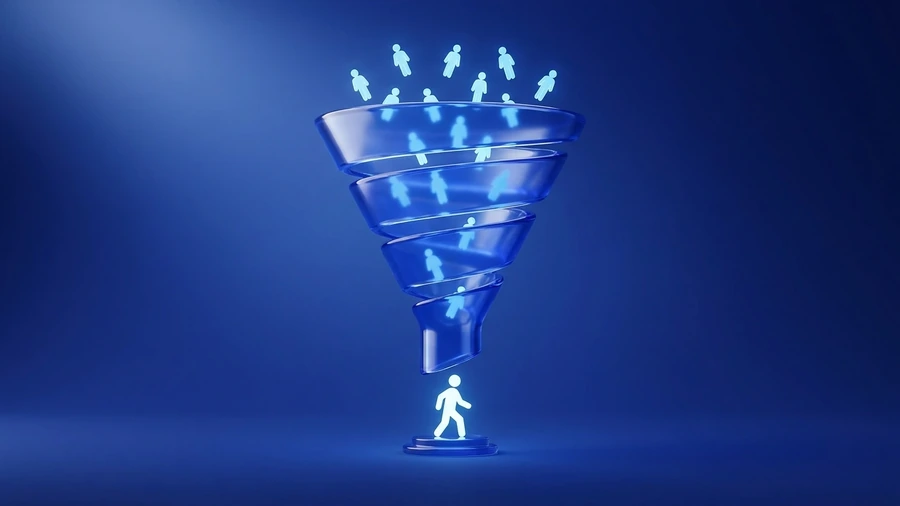
A marketing funnel is a model. It maps how a stranger learns you exist, weighs buying from you, becomes a customer, and comes back for more. It is called a funnel because the crowd narrows at each stage. Thousands might see an ad, hundreds click through, and only a handful buy. Each business has a funnel, whether it has mapped one or not. The real question is whether it works or leaks leads at each stage.
Why the Funnel Shape Matters
The funnel shape is not just a metaphor. It reflects a real math problem each business owner deals with. Say 1,000 people see your Google Ads and only 2 buy. That is a 0.2% conversion rate through the whole funnel. Knowing where those 998 people dropped off tells you exactly where to fix things.
Say a roofing company runs Facebook ads and gets 500 clicks to its site in a month. Only 10 of those become quote requests. The leak is somewhere between the click and the form. It may not be in the ad at all.
- Leak finder. The funnel shows which stage loses the most people, so you fix the real problem instead of guessing.
- Budget guide. Your funnel tells you whether to spend more at the top (awareness) or the bottom (conversion).
- Team alignment. Marketing and sales can point to the same stages instead of arguing over whose fault a slow month is.
Marketing Funnel vs. Customer Journey
The customer journey and the marketing funnel cover the same basic path from two angles. The customer journey is about the buyer’s experience and feelings at each touchpoint. The marketing funnel is about the business’s actions and numbers at each stage.
Most small business owners do not need to split hairs between the two. What matters is a clear picture of the path prospects take, and the right message for each stage.
More traffic through the same leak still loses the same share of customers. It just loses more of them.
The 5 Stages of the Marketing Funnel
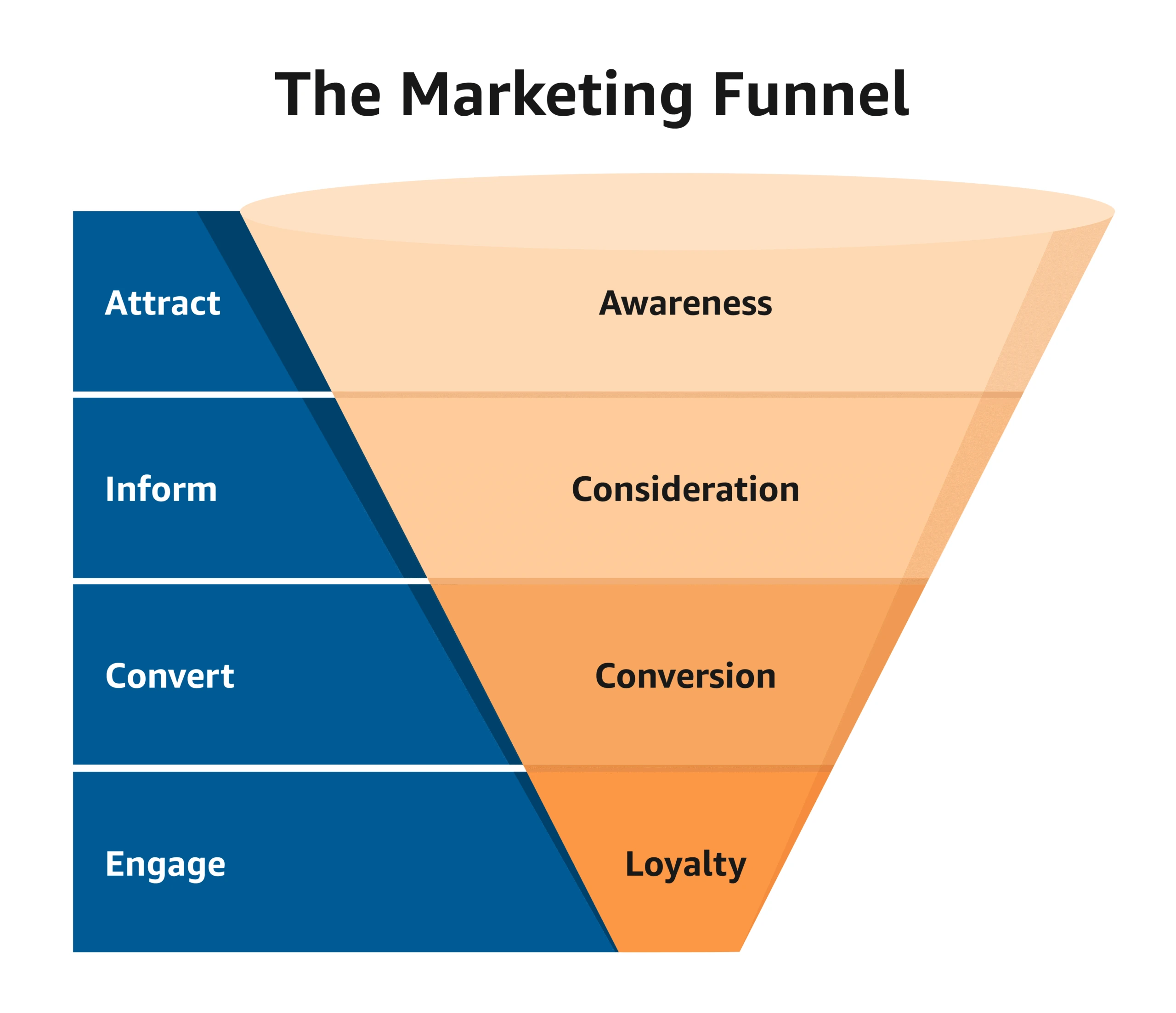
The 5 stages of the marketing funnel are awareness, interest, consideration, conversion, and loyalty. Some models compress this into 4 stages: awareness, consideration, conversion, and retention. Each stage needs its own message, its own content, and its own success metric. Treating each stage the same is the most common reason funnels fall short.
Awareness: Getting Found
Awareness is the top of the funnel, where someone first learns you exist. SEO, social media, and paid ads do their heaviest lifting here. The person does not know you yet and is not ready to buy.
Take a dental practice. Awareness might be a local search result for “emergency dentist near me” or a helpful Facebook post about tooth pain. A strong Google Business Profile plays a huge role here for any local business. Most people check a business on Maps before they ever visit its website.
- SEO content. Blog posts, service pages, and local listings that answer the questions your future buyers search now.
- Social ads and posts. Instagram, TikTok, and Facebook content that puts your brand in front of people who fit your ideal buyer.
- PR and referrals. Local news mentions, community sponsorships, and word of mouth that plant your name in someone’s memory.
Interest and Consideration: Earning Trust
Interest and consideration are the middle stages. The prospect knows who you are and starts to compare options. Blog content, case studies, reviews, and email nurture do the heavy lifting here. The prospect is now asking, “Is this the right business for me?”
A property management company at this stage might send a case study to an owner it hopes to sign. It shows how the company cut vacancy time by three weeks for a similar property. A med spa might lean on before-and-after photos and verified reviews to move someone from curious to convinced.
- Comparison content. Pages that answer “why choose us over competitor X” head on.
- Email nurture. A run of 3 to 5 emails that answers doubts and builds trust over 1 to 2 weeks.
- Social proof. Reviews, testimonials, and case studies. Getting and keeping good reviews matters here, since one bad review can undo weeks of nurture.
Conversion and Loyalty: Closing and Keeping
Conversion is the moment someone becomes a paying customer. That might be booking a visit, signing a lease, or checking out. Loyalty, the final stage, turns a one-time buyer into a repeat buyer and a referral source. It is the stage most small businesses neglect the most.
Law firms and home services businesses in particular tend to stop marketing the moment a deal closes. Take a plumber who follows up 11 months after an install. The follow-up reminds the customer that the water heater warranty is about to run out. That captures repeat revenue a rival would otherwise win.
- Clear paths to buy. Simple forms, visible phone numbers, and fast page loads remove friction right before the sale.
- Onboarding and follow-up. A confirmation call or email that sets expectations builds trust right after the sale.
- Retention campaigns. Email or SMS reminders, loyalty offers, and review requests that bring past customers back.
| Aspect | Marketing Funnel | Sales Funnel |
|---|---|---|
| Primary owner | Marketing team or agency | Sales team |
| Starting point | Someone becomes aware your business exists | Someone becomes a qualified lead |
| Ending point | Customer loyalty and repeat business | Closed deal or signed contract |
| Core tools | SEO, ads, social content, email nurture | CRM, follow-up calls, proposals, demos |
| Best measured by | Cost per lead, conversion rate by stage | Close rate, deal size, sales cycle length |
Marketing Funnel Examples by Industry
A marketing funnel example shows how each stage turns into real tactics for one type of business. That is more useful than a stock diagram. Below are funnel breakdowns for a few common industries. The same 5-stage structure looks different in each one.
Roofing and Home Services Funnel
A roofer’s funnel often starts with a storm or a roof that looks old. That creates urgent, high-intent searches. Awareness comes from Google Ads on terms like “roof repair [city]” and from local SEO. Interest comes from a fast site with clear pricing ranges and financing info. The sale comes from a quote form that is easy to find.
The loyalty stage is where many roofers leave money on the table. Send a maintenance reminder or referral reward 2 to 3 years after the install, right when the roof is due for a check. That keeps the relationship alive.
Real Estate and Property Management Funnel
For real estate agents and property managers, awareness often comes from three places: Google Business Profile, Instagram ads that show off listings, and posts about each neighborhood. Consideration is where virtual tours, market reports, and testimonials from past clients do the convincing.
Conversion in this industry can take weeks or months. That is why email nurture and retargeting ads matter more here than in almost any other niche on this list. Loyalty means staying top of mind for the next move, the next investment property, or the next referral.
Med Spa and Dental Practice Funnel
Med spas and dental practices lean on visual proof at the consideration stage. Before-and-after photos, video testimonials, and verified reviews carry more weight than almost any ad copy. Awareness often comes from a mix of Instagram content, local SEO, and paid social aimed at people searching for a given treatment.
These businesses earn repeat revenue, so the loyalty stage may be the most valuable part of the funnel. One happy Botox or cleaning patient who returns every 3 to 6 months is worth far more over time than a one-time visitor. That is why membership programs and automatic appointment reminders show up so often in this space.
Marketing Funnel vs. Sales Funnel
A marketing funnel and a sales funnel are related but not the same. The marketing funnel covers the full journey from stranger to loyal customer. The sales funnel often starts once a lead is qualified and ends at the closed deal. Mixing the two up is a common reason marketing and sales end up at odds over what “a lead” even means. The same goes for an owner who wears both hats.
Where the Overlap Happens
The overlap is the middle of the marketing funnel, roughly the consideration stage. That is where a marketing-qualified lead becomes a sales-qualified lead. A law firm’s marketing funnel might bring in the first consult request. The sales funnel (the lawyer’s follow-up calls and proposal) takes over from there.
Small businesses that run marketing and sales through one person or one small team often blend these into a single pipeline. That is fine, as long as they still track conversion rates at each distinct stage.
Why the Distinction Matters for Budgeting
Knowing which funnel falls short tells you where to invest. If plenty of leads come in but few close, the problem is likely in the sales funnel: follow-up speed, pricing, or sales scripts. It is not the marketing.
If very few people even reach out, the marketing funnel needs the work: more traffic, better offers, or clearer calls to action on the site.
How to Build a Marketing Funnel That Converts
Building a marketing funnel that converts starts with mapping your real customer path, not copying a stock template. Then match content and channels to each real stage. The goal is not a prettier diagram. It is fewer people dropping off between stages.
Step 1: Map Your Current Funnel
Before you add anything new, write down what happens now. Where do people first find you? What do they see next? Where do they tend to stop replying? Most owners are surprised how much they can answer from Google Analytics or a CRM. Even phone call logs help.
This step alone often reveals the biggest leak.
A dental practice finds that 60% of its website visitors never reach the contact page. That points to a site speed or navigation problem, not an ad problem.
Step 2: Match Content to Each Stage
Each piece of content should have one clear funnel stage. Awareness content answers broad questions. Consideration content compares options and builds trust. Conversion content removes the last friction, like unclear pricing or a clunky contact form.
Social media often works best split across stages too. Some posts introduce the brand to new audiences. Others, like client results or reviews, nudge warm followers toward booking.
- Awareness assets. Blog posts, short video, and local SEO pages.
- Consideration assets. Case studies, comparison pages, FAQ content, and email sequences.
- Conversion assets. Landing pages, clear pricing, and simple contact forms.
- Loyalty assets. Review requests, loyalty offers, and win-back email or SMS campaigns.
Step 3: Use Paid Ads to Fill Specific Gaps
Paid ads should target the stage where you lose the most people, not just “more traffic” in general. Searches like “emergency plumber near me” show high intent, and Google Ads works well there, at the bottom of the funnel. Facebook and Instagram ads tend to do better at the top of the funnel. They also work well to retarget warm leads who have visited the site before.
Retargeting in particular recovers a huge chunk of funnel drop-off. The vast majority of visitors leave without converting on their first visit. A retargeting ad that simply reminds them of the offer they viewed can bring a good share back.
Measuring and Fixing a Leaky Funnel
You fix a leaky funnel by measuring the conversion rate between each stage, not just the end result. That way you can pinpoint where prospects drop off. Looking only at total leads or total revenue hides which stage needs the work.
The Metrics That Actually Matter
Impressions and clicks tell you almost nothing about revenue on their own. They are the vanity metrics that make a report look busy without proving business impact. What matters is cost per lead, the lead-to-customer conversion rate, and customer lifetime value. Those numbers connect straight to what the business earns.
A business owner should be able to answer three questions. How much does it cost to generate one lead? What share of leads become customers? How much is each customer worth over time? Those three numbers, tracked consistently, reveal more than any traffic dashboard.
The 3:3:3 Rule and Other Quick Diagnostics
The 3:3:3 rule in marketing is a content shortcut. A piece of content should be clear in 3 seconds, deliver value in 3 minutes, and stay relevant for 3 months. It is mostly used as a check on top-of-funnel content like social posts and blog intros. It is not a funnel stage model itself. But it is a useful filter for whether your awareness content is doing its job.
Beyond that rule, the fastest check is a stage-by-stage drop-off audit. Pull the numbers for how many people saw your ad, clicked through, filled out a form, and became paying customers. Then look for the single biggest drop. That is almost always where the fix belongs first.
When to Bring in Outside Help
Some funnel leaks are simple fixes: a confusing contact form or a slow page. Others need deeper work: a website redesign, a full SEO audit, or rebuilding an ad account that has aimed at the wrong audience for months.
Judge funnel fixes by whether leads and revenue improve. That means finding the leak has to come before the spending. Find the leaking stage first. A broken middle-of-funnel nurture sequence and loose Google Ads targeting both quietly waste money. Neither shows up in a traffic report.
Free Marketing AuditA read of your Search Console: every term you rank for, its real position, and which are close to page one.Frequently Asked Questions
What are the 5 stages of the marketing funnel?
The 5 stages of the marketing funnel are awareness, interest, consideration, conversion, and loyalty. Awareness introduces the business. Interest and consideration build trust and compare options. Conversion is the sale itself. Loyalty turns a customer into a repeat buyer.
What are the 4 stages of the marketing funnel?
Some models simplify the funnel into 4 stages: awareness, consideration, conversion, and retention. This merges interest and consideration into one stage and treats loyalty as ongoing retention. It covers the same path as the 5-stage model.
What is the marketing funnel?
A marketing funnel is a model of the path from first finding a business to becoming a paying, repeat customer. It narrows at each stage, because fewer people move forward than entered at the top. That is why it is shaped like a funnel. This guide walks the marketing funnel stages with examples at each step. You see the model applied to a real business, not in the abstract.
What is the 3 3 3 rule in marketing?
The 3:3:3 rule says content should be clear in 3 seconds, deliver value within 3 minutes, and stay relevant for 3 months. It is often a check on top-of-funnel content like social posts, blog intros, and short video.
What is the difference between a marketing funnel and a sales funnel?
A marketing funnel covers the full journey from stranger to loyal customer. A sales funnel usually starts once a lead is qualified and ends at the closed deal. The marketing funnel is broader. It includes the awareness and loyalty stages that a sales funnel leaves out.
How do you build a marketing funnel for a small business?
Start by mapping your current customer path with your analytics or CRM data. Then match content and ads to each funnel stage instead of one message for all. Track conversion rates between stages, so you can find and fix the biggest drop-off point first.
What is a marketing funnel example in digital marketing?
A common example is a home services business. It runs local SEO and Google Ads for awareness, then a fast website with reviews for consideration. A simple quote form handles conversion. A follow-up email or maintenance reminder handles loyalty. The exact tactics change by field, but the 5-stage structure stays the same.
How is a marketing funnel different from a customer journey?
The customer journey covers the buyer’s experience and feelings at each touchpoint. The marketing funnel covers the business’s actions and metrics at each stage. Both map a similar path, just from two points of view.
Do I need a marketing funnel?
You have one now. Each business has a path from first contact to sale, whether anyone has mapped it or not. What you need is a map of it. Once you know how many people move from each stage to the next, you can see which stage leaks. Then you fix that one first.
What is the marketing funnel also known as?
People often call it the sales funnel, the pipeline, or the customer journey. Marketers also talk about the top, middle, and bottom of the funnel. The names overlap but are not the same. A sales funnel starts at a qualified lead, and the customer journey is the buyer’s side of the path. This guide uses the five-stage marketing funnel.
Do you need software to build a marketing funnel?
No. A funnel is a map of your customer path. You can draw the first version from what you have now: Google Analytics, your CRM, or even your phone call logs. A tool only helps once you know which stage you are measuring. The map and the numbers matter more than the software.
What is a lead generation marketing funnel?
It is the same funnel measured by leads instead of sales. Awareness and interest bring people in, consideration turns them into qualified leads, and the sales funnel takes over from there. The numbers to watch are cost per lead and the share of leads that become customers, tracked stage by stage.
How much does it cost to fix a marketing funnel?
It depends on which stage leaks. A confusing contact form or a slow page is a small fix. A website redesign, a full SEO audit, or rebuilding an ad account is bigger work. Find the leak first, so the spending goes to the stage that is losing people. Our pricing page explains what moves the size of the work.
Turn Your Funnel Into a Revenue Engine
A marketing funnel only earns its name if people keep moving through it. That means from a first Google search or social post all the way to a repeat customer who refers a friend. The stages, from awareness to loyalty, are not abstract theory. They are the exact places where real businesses gain or lose revenue each month.
Not sure where your funnel is leaking? Pouring budget into ads with no plan for the middle and bottom stages? Get a free audit from Kihan Marketing. We will show you exactly where prospects drop off and what it would take to fix it. We measure that in leads and revenue, not impressions.
Want to know where your site stands? Ask for a free marketing audit.