


TL;DR
Healthcare content marketing done right means publishing useful, accurate content with real expertise behind it. Google files most health content under “Your Money or Your Life.” So it weighs experience, expertise, authority and trust (E-E-A-T) harder than in any other niche. The winners name an author with credentials, cite sources, show real clinical experience, and keep medical claims tight. The result is not vanity traffic. It is patients who book. Skip the fluff, build trust signals, and count bookings, not pageviews.
Google holds health content to its strictest bar, so trust has to show on the page. Name the author and a medical reviewer, with their credentials. Cite primary sources and show real clinical experience. Build each page around a question patients ask before they book. Then judge the work by bookings, not traffic.
What Healthcare Content Marketing Actually Is
Healthcare content marketing is the practice of publishing content that earns trust, ranks in search, and turns readers into patients. That content can be articles, guides, FAQs, or condition pages. Notice what that leaves out: posting to “stay active,” chasing word counts, or writing thin blog posts no one reads.
We do not publish content that exists only to fill a calendar. In healthcare, that habit is worse than useless. Google checks health content harder than almost any other topic. Wrong or hollow pages can drag down your whole domain.
Good healthcare content marketing answers the questions real patients type before they book. They want to know what a procedure involves, what it costs, and who is a candidate. They also ask what recovery looks like and how to choose a provider. Done well, it pulls in the right search traffic, builds trust before the first call, and shortens the path from question to booking.
E-E-A-T: Why Google Holds Health Content to a Higher Bar
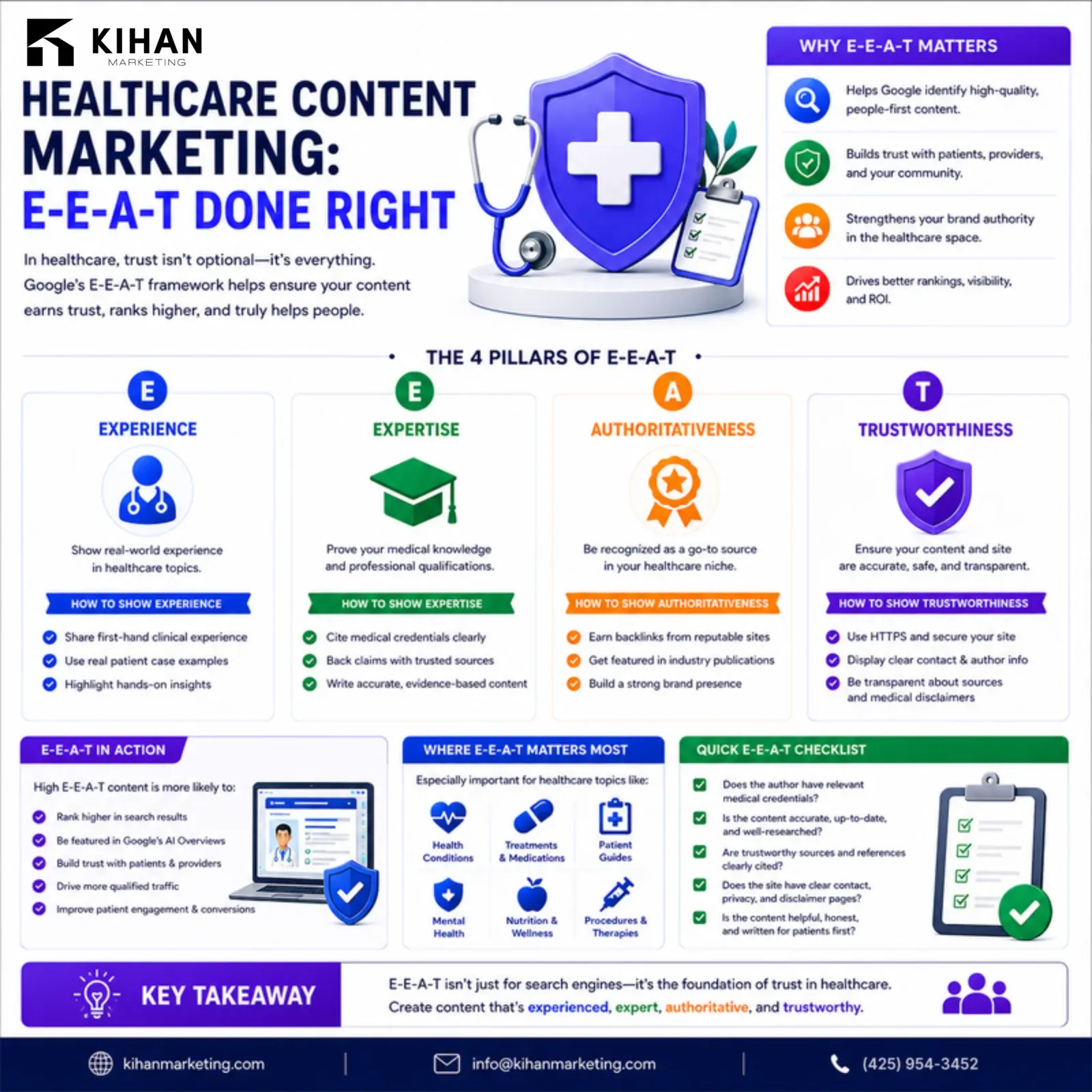
E-E-A-T stands for Experience, Expertise, Authoritativeness, and Trustworthiness. It is not a ranking factor you can switch on. It is the framework Google’s quality raters use to judge whether a page deserves to rank. For most medical, dental, and wellness topics, Google applies its strictest standard: the “Your Money or Your Life” (YMYL) bar. The reason is simple. Bad health advice can hurt someone.
A roofing site can sometimes rank with average content. A medical practice usually cannot. The same bland article that limps along in a low-stakes niche gets buried in healthcare. Google is looking hard for reasons to trust or distrust the source.
This is why good healthcare content marketing is also trust-building. You are not just writing. You are proving, on the page, that a qualified human stands behind the words. If your SEO base is weak, even great content struggles. The two have to be built together.
The 4 E-E-A-T Signals That Move Rankings
Here is how the four parts turn into things you do on the page:
|
E-E-A-T Component |
What Google Looks For |
How to Show It |
|
Experience |
First-hand, real-world involvement |
Case examples, real outcomes, “what we see in our patients” framing |
|
Expertise |
Credentialed knowledge |
Named author with title (MD, DDS, RN, PT), detailed bio |
|
Authoritativeness |
Recognition by others |
Citations to your work, links from medical orgs, reviews |
|
Trustworthiness |
Accuracy and transparency |
Sources cited, medical reviewer noted, clear contact and policies |
Trust is the foundation. The other three feed it. A few moves that punch above their weight:
- Name the author and reviewer. A real clinician byline with credentials beats “by Admin” each time.
- Cite primary sources. Link to peer-reviewed studies or official health bodies, not other blogs.
- Show experience plainly. How many patients you see, the usual timelines, and honest tradeoffs all read as lived experience.
- Keep your contact and trust pages clean. A complete profile, a real address, and accurate Google Business Profile optimization all build trust.
Mistakes That Quietly Kill Healthcare Content
Most healthcare sites never get a big penalty. They just quietly fail to rank, and no one can say why. The usual culprits:
- Content with no author. No name, no credentials, no reviewer. Google cannot check the expertise, so it assumes there is none.
- Promising a cure or a certain result. This erodes trust and creates compliance risk.
- Thin, templated pages. Ten near-copies of one service page with the city swapped in. Patients and crawlers both see through it.
- No sourcing. Health claims with no sources read as opinion, not authority.
- Ignoring the technical base. Slow, hard-to-crawl sites undercut even great content. A fast, well-built website development base is part of E-E-A-T, not a separate job.
We do not chase vanity metrics, and this is where that discipline pays off. A post that gets shares but no bookings is not a win. A page that ranks for the exact question a patient asks before booking is.
A Healthcare Content Framework That Generates Patients
A healthcare content marketing strategy that works follows the same steps each time. It is built around what patients want, not internal talking points.
Step 1: Map the patient journey. List the real questions at each stage, from “is this normal” awareness queries to “best provider near me” decision queries. Each one becomes a content target.
Step 2: Assign the right page type. Awareness questions get articles that explain. Procedure questions get detailed service pages. Decision questions get pages that compare options and cover cost, plus strong calls to action.
Step 3: Build in E-E-A-T at the source. Brief a real clinician, capture their experience, cite sources, and credit the reviewer. Do not bolt trust on afterward.
Step 4: Connect content to conversion. Every page needs a clear next step: book a consultation, call, or ask for details. Content without a next step is a library, not a lead generation engine.
Step 5: Refresh, do not just publish. Medical facts go out of date. Update statistics, guidelines, and pricing on a schedule so the facts stay correct and the rankings hold.
One more habit separates practices that win: linking pages together and covering a topic in depth. A single article rarely ranks alone. Google rewards sites that cover a topic in full. So a strong condition page should link to related procedure pages, cost guides, and FAQs. That cluster signals real authority. We do not publish orphan posts that sit alone. Each piece should support the others and guide the reader one step closer to booking.
This is also where local relevance builds on itself. A practice that pairs deep clinical content with steady local signals tends to beat two kinds of rival: thin local competitors, and far-off national chains with no real local presence.
This framework works across specialties, from dental and physical therapy to med spas and primary care. The intent map changes. The discipline does not.
Measuring ROI: Beyond Traffic and Vanity Metrics
Traffic is an input, not a result. We measure healthcare content marketing on the metrics that pay the bills:
- Consultations booked from organic search. The number that matters.
- Cost per acquired patient. Content has a long shelf life, so cost per patient tends to drop over time.
- Assisted conversions. A helpful article often plays a part in a booking, even when the last click comes from somewhere else.
- Keyword-to-revenue mapping. Which queries lead to high-value procedures, not just high volume.
We also track which pages earn AI citations. More patients now ask AI tools to suggest a provider. Content that is well built, sourced, and trustworthy shows up in those answers more and more. That does not always show in a rankings report. But it brings real inquiries, and it rewards the exact E-E-A-T discipline this article describes.
A practice that publishes ten patient-focused, E-E-A-T-rich pages and tracks bookings will learn more in 90 days than one chasing pageviews for a year.
If you want a clear read on where your current content stands, a free marketing audit will show the gaps.
Related reading
- Healthcare Marketing Compliance: HIPAA-Safe SEO and Ads
- Chiropractor Marketing: Ranking for Pain-Relief Keywords
- Physical Therapy Marketing: Beating the Big Networks
FAQ: Healthcare Content Marketing
What makes healthcare content marketing different from other industries?
Google treats most health topics as “Your Money or Your Life” and applies its strictest E-E-A-T standard. Content needs a real expert, sources, and correct facts to rank. Lower-stakes niches can get away with less.
Do I really need a credentialed author byline?
For health content, yes. A named clinician with visible credentials is one of the strongest trust signals you can add. Pages with no named author consistently do worse in YMYL topics.
How long until healthcare content marketing produces patients?
Expect early ranking movement in 3 to 6 months, and compounding results after that. Content is a durable asset. So cost per new patient tends to improve the longer good pages stay live.
Can I use AI to write healthcare content?
You can use AI to help, but AI medical content that no one has checked is a risk. A qualified human must check the facts, add real experience, and approve each claim. Otherwise you risk both patient harm and lost rankings.
Is content marketing or paid ads better for a medical practice?
They do different jobs. Ads get you seen right away. Content builds a lasting, lower-cost patient pipeline and builds trust. Most practices get the most from funding both, and letting content cut how much they rely on ads over time.
How much does healthcare content marketing cost?
It depends on the scope, not a set package. Three things move the cost: how many patient questions you want to cover, whether a clinician has to be briefed and credited on each page, and how solid your site’s SEO is. A free marketing audit shows what you need first. Our pricing page explains how we scope work.
Does the doctor have to write every article?
No. A writer can interview the clinician and draft the page. The clinician then checks the facts, adds what they see in their own patients, and is credited as author or medical reviewer. That is the part Google looks for: a named, qualified person standing behind the page, not who did the typing.
How often should a medical practice publish new content?
There is no magic number. Publish when you have a real patient question worth answering and a clinician to stand behind the answer, and no sooner. A page that only fills a calendar slot helps nothing. Put the same effort into refreshing what you already have. Medical advice changes, and stale pages lose both accuracy and rankings.
Which pages should a healthcare practice write first?
Start with the questions patients ask right before they book: what the procedure involves, who is a candidate, what recovery looks like, and how to choose a provider. Those pages sit closest to a booking. Then add awareness articles that link into them, so the cluster builds authority instead of leaving orphan posts.
Healthcare content marketing rewards substance and punishes shortcuts harder than any other niche. That is why it is such a lasting edge once you do it right. If you want a partner that builds trust signals and measures patients instead of pageviews, start with a free marketing audit. We will show you where the real gains are.