


TL;DR
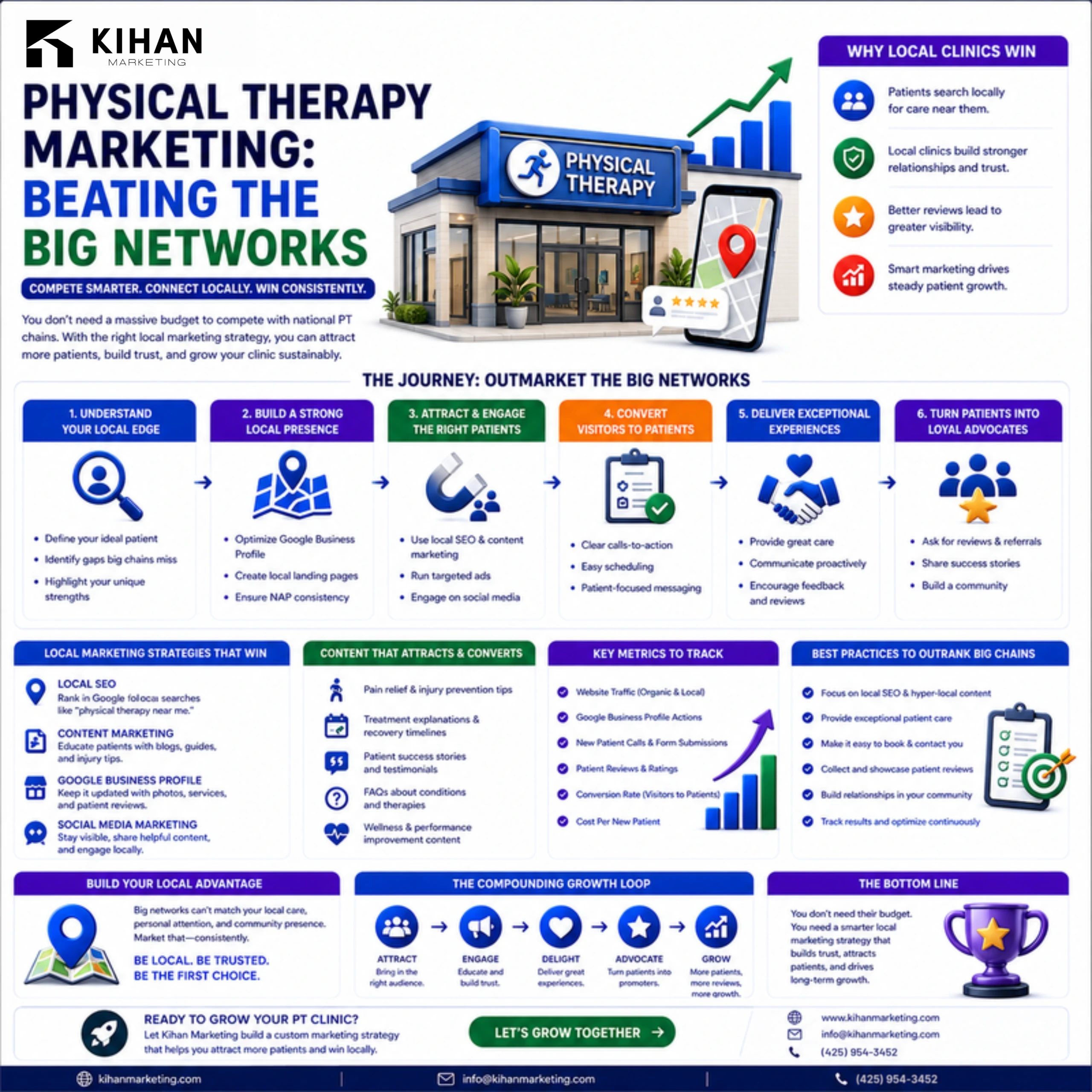
Physical therapy marketing is not a spending contest. Independent clinics beat big hospital networks online by winning local search. The playbook is narrow and proven. You need a fully optimized Google Business Profile and a fast website built to book appointments. Add location-specific pages and a steady stream of real patient reviews. Done right, physical therapy SEO can put a single-location clinic above national chains for “physical therapist near me” searches. It can happen within 4 to 8 months. And it often costs a fraction of what the networks waste on broad branding.
A single PT clinic can outrank the big networks in its own area. Do not try to outspend them on broad terms. Win the local searches that fill your schedule instead. Fix your Google Business Profile, build a fast site that books visits, write pages for the conditions you treat, and earn a steady stream of real reviews.
Why Independent PT Clinics Lose to Big Networks Online
Big hospital networks and PT chains are not better at therapy than independent clinics. They win because they show up first when a patient with a sore knee opens Google. They have full-time SEO teams and hundreds of location pages. Their sites have also built up strength in search over a decade, which SEOs call domain authority.
Here is what most clinic owners get wrong: they try to compete on the network’s terms. They chase the same broad keywords that everyone wants. They pour money into ads that target no one in particular. They obsess over follower counts. That is a losing game. The networks have more budget and more pages, and on brute force they will outlast you every time.
The clinics that win flip the plan. They stop trying to be everywhere. Instead, they own the few searches that actually fill the schedule. That shift, from vanity reach to local intent, is the whole base of good physical therapy SEO.
The Local SEO Advantage Networks Can't Replicate
A national network has one big weakness: it cannot be truly local everywhere at once. Its location pages come from one template. Its reviews are spread thin across hundreds of sites. And its phone trees frustrate the very patients you see in person.
That is your opening. Google’s local ranking looks at three things for a given area: relevance, proximity and prominence. A focused single-location clinic can beat a national page on all three:
- Relevance: Your site can speak straight to one city and the conditions you actually treat.
- Proximity: You are physically in the neighborhood the searcher is in.
- Prominence: Reviews and directory listings focused on one area outweigh a chain’s scattered ones.
Our local SEO work is built around that. Local SEO rewards focus. And focus is the one thing a sprawling network cannot do well.
Google Business Profile: Your Highest-ROI Asset

If you do one thing this quarter, fix your Google Business Profile. For local healthcare searches, the map pack gets most of the clicks. That is the top three results with the map. Patients click there before they ever scroll to the regular listings.
A profile that wins is not “set and forget.” It needs:
- The right name, address and phone, matching your website exactly.
- The right main category (Physical Therapist) and useful second categories.
- Photos of the real clinic, staff and equipment, updated often.
- Services and conditions listed in detail.
- A steady flow of recent reviews, each with an owner reply.
- Regular posts and quick answers to questions.
Clinics that treat the profile as a living asset often outrank chains in the map pack. Getting it right is the biggest single lever in local healthcare marketing. It is what our Google Business Profile optimization covers.
Building a Website That Converts Patients
Ranking is worth nothing if the click does not become a booked visit. We have seen clinics rank well and still struggle. Their website was quietly turning patients away.
A PT website that converts does a few things, every time:
- Loads fast on mobile. Most “near me” searches happen on a phone. A slow site loses patients before it even loads.
- Makes booking obvious. Put a “Request Appointment” or click-to-call button on every screen. Do not bury it in a menu.
- Answers the patient’s real question. Say what you treat and whether they need a referral. Say whether you take their insurance and how soon they can be seen.
- Builds trust fast. Show real photos, therapist credentials and genuine reviews near the top of the page.
Good physical therapy SEO brings the traffic. But website development built to convert is what turns that traffic into revenue. Ranking and converting are two different jobs. Skip the second, and you waste the first. The whole point is lead generation, not applause.
Content and Reviews That Win Local Search
Content for a PT clinic should not read like a medical journal or a press release. It should answer the questions real patients type before they book.
One patient asks “how long does physical therapy take for a torn rotator cuff” before booking. Another wants to know “do I need a referral for physical therapy” as well. A third searches “PT for lower back pain near me” to find a clinic nearby. Each of those questions can become its own focused page, aimed at one need in one area.
Stack these pages together and they tell Google your site is the local authority on physical therapy. That is the core of any lasting physical therapy SEO strategy.
Reviews work in parallel. A steady flow of recent, detailed reviews does two things. It lifts your prominence in local search. And it convinces the next patient to pick you over the chain down the road. Ask every happy patient, and make it easy with a direct link. Reply to each one. Both volume and recency count, so a steady habit beats a one-time push.
What We Don't Do (and Why)
Plenty of agencies will sell a PT clinic things that look good in a report and do nothing for the schedule. We do not.
- We don’t chase vanity metrics. Followers, impressions and “reach” do not pay your rent. Booked appointments do.
- We don’t buy fake reviews. It breaks Google’s policies and puts your profile at risk. Patients see through it, too.
- We don’t lock you into broad, unwinnable keywords. Taking on national chains head-on for generic terms burns budget.
- We don’t pad reports with activity that hides a lack of results. If the phone is not ringing more, something needs to change.
That discipline is the gap between marketing that performs and marketing that just looks busy. Honest physical therapy SEO is measured in patients, not pageviews.
How to Size a Physical Therapy SEO Budget
Three things set the size of the work. First, whether you are one clinic or several. Second, how many conditions you want to be found for. Third, how much local SEO groundwork the site already has.
A single clinic competing in one suburb needs far less work. A two-clinic practice trying to cover a whole metro, across a dozen conditions, needs much more.
Our pricing page sets out how we structure the work. The fastest way to find your own gaps is a free, no-obligation marketing audit.
Related reading
- Healthcare Content Marketing: E-E-A-T Done Right
- Healthcare Marketing Compliance: HIPAA-Safe SEO and Ads
- Chiropractor Marketing: Ranking for Pain-Relief Keywords
FAQ: Physical Therapy Marketing
How long does physical therapy SEO take to work?
Most independent clinics see real local ranking and call growth within 4 to 8 months. The Google Business Profile often brings results faster than the pages on your site.
Can a single clinic really outrank a hospital network?
Yes, in local search. Networks own the broad national terms. But a focused clinic can beat them on relevance, proximity and prominence for “near me” searches in its own area.
Is Google Business Profile or my website more important?
Both matter. For new patient calls, the Google Business Profile usually pays off fastest. Your website then turns that visibility into booked appointments.
Do I need to blog to rank?
You do not need a constant blog. But pages that answer common patient questions make physical therapy SEO much stronger. They also catch people who are ready to book.
How much should an independent PT clinic spend on marketing?
Most single-location clinics start with basic local SEO. They scale up once the flow of new patients proves it pays. Getting found in your own suburb comes first. Competing across a metro is a later problem.
What is physical therapy marketing?
Physical therapy marketing is how a clinic gets found by patients nearby and turns them into booked visits. For an independent clinic, that means local search first. The core parts are a strong Google Business Profile and a fast website that books appointments. Add pages for the conditions you treat and a steady flow of real reviews.
Which keywords should an independent PT clinic target?
Target the searches your own patients make, in your own area. Think of a condition plus “near me,” or the questions patients ask before they book, like whether they need a referral. Skip the broad, generic terms the national chains own. Those burn budget and rarely fill your schedule.
Should a PT clinic hire a physical therapy marketing agency?
Hire one only if it measures success in booked appointments. Be wary of an agency that sells followers, reach or broad keywords, or that offers to buy reviews. Ask how it will improve your profile, your site and your review flow. A free marketing audit shows where your gaps are first.
Should a PT clinic focus on social media or local SEO first?
Start with local SEO. Followers and reach do not fill a schedule, and patients with a sore knee search Google, not a feed. Fix your Google Business Profile first, since it usually pays off fastest. Then make sure your website turns those visits into booked appointments.
The big networks are not unbeatable. They are just better organized than the average independent clinic. That gap closes fast once you focus on local intent instead of broad reach. Win the map pack, convert the clicks and earn real reviews. Then physical therapy SEO will put your clinic in front of patients the chains are too generic to reach. Start with a free marketing audit to see exactly where you stand. Then explore our approach to lead generation, built for clinics that want patients, not vanity metrics.