

This is a plain guide to AI marketing. It covers what AI marketing is, where it helps a small business, and where it still falls short. It also shows the simplest way to start without wasting money or your weekend.
If you run a small business, people have probably told you to “use AI for marketing.” Most of them could not tell you what that means. This guide is for you. There is no jargon, no enterprise pitch and no long tour of features you will never use. You get the working knowledge a small business owner needs: what AI marketing is, what it can do for you, and what it cannot do at all.
Who this guide is for: owners of local service businesses, small in-house marketers, and operators. It is for anyone who wants a clear picture of AI in marketing before spending money on tools or agencies. By the end, you will know what to ask for, what to skip, and what to do this week.
AI marketing means using software to do the production side of your marketing faster: drafts, research, ad variants and reports. Strategy, brand voice and customer relationships stay with a human. Start with one weekly job, one tool and one saved prompt. Edit everything before it goes out, and track one number that pays your bills.
What you'll take away
- A working definition of AI marketing, with no glossary needed.
- Five places it really helps, and five where it still gets you into trouble.
- A four-step starter plan any owner can run without hiring anyone.
- Shortcuts for roofing, med spa, real estate and property management.
- The honest mistakes we see small businesses make again and again.
Short on time
If you only remember five things about AI marketing this year
01
It is a power tool, not a strategist.
Use AI to produce more, faster. The choice of what to produce still belongs to a human.
02
Pick one tool. Get fluent.
One tool you use every day beats five tools you barely touch. Add the next one only when the first becomes a bottleneck.
03
Edit everything before it ships.
AI gets you a draft. A human still has to add the point of view, the example and the voice.
04
Automate production, keep relationships human.
Customers can spot an auto-reply faster than you think. Automate behind the scenes, and stay personal on the front line.
05
Measure one outcome.
Pick the number that pays your bills and track it. If AI is moving it, you’re winning. If not, the problem is upstream.
Chapter 01 · Definitions
What "AI marketing" actually means in 2026
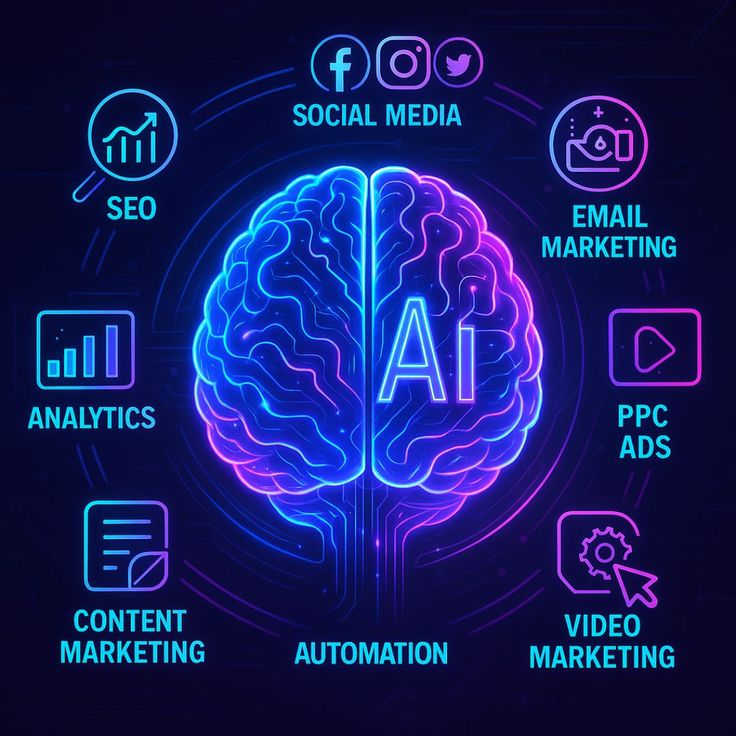
“AI marketing” is a confusing phrase. It covers two different things that get sold together. The first is the AI you probably already use: chat tools like Claude or ChatGPT that read, write, summarize and answer questions. The second is the AI built into the platforms you already pay for. That means the auto-bidding inside Meta and Google Ads and the suggested replies in your inbox. It also means the “people who liked this also liked” engines inside email and e-commerce tools.
For a small business, the working meaning is simpler than most articles make it sound. AI marketing is using software that can read, write, summarize, or make images and video. You use it to do the production parts of your marketing faster and cheaper. The strategy, the brand voice and the relationships with customers still belong to a human. AI is a power tool. It does not replace the person holding it.
The shift that matters is not about technology. It is about cost. The cost of producing competent marketing has collapsed.
Take one blog post. It used to take a freelancer most of an afternoon. With AI, the draft now takes a fraction of that time.
So the edge moves from who can afford to produce to who has good judgment about what to produce. Small businesses with clear positioning, and the discipline to use AI consistently, can now out-publish much larger competitors.
“The advantage moves from who can afford to produce, to who has good judgment about what to produce.”
The 2026 shift
Chapter 02 · The honest map
Five places AI genuinely helps a small business
Where AI earns its keep
Content drafting
Service pages, FAQs, blog posts, email newsletters and social captions. AI takes you from a blank page to a first draft in minutes. A human still does the final edit. But the most painful part of the job is now the cheapest.
Research and analysis
AI can read dozens of competitor pages, sum up long PDFs and pull structured data out of a website. Work that used to fill an afternoon now fits in a coffee break.
Creative production
Ad headlines, image variants, social tile graphics and alt copy for landing pages. AI cannot replace a photographer. But it can make enough variety for proper testing, and testing is where the real lift in conversions comes from.
Personalization at the edges
Email subject lines written for one customer group. Follow-up messages that mention the last service a client booked. Page copy that changes for different cities. AI handles the boring repetition that humans never had time to do well.
Reporting and insight
AI can turn a wall of analytics into a paragraph that says what changed and why. That helps when you have ten clients or ten locations and cannot review every dashboard by hand.
Where AI still falls short
Strategy and positioning
AI is good at producing options. It is bad at picking the right one for your market, your customer and your stage. The hardest decisions, the ones that matter most, still need a human with skin in the game.
Brand voice without heavy editing
Out of the box, AI sounds confident, generic and a little hollow. That is fine for a first draft. It is bad as a published voice unless a human adds personality and edits out the tells.
Real customer relationships
An auto-reply that pretends to be human wears thin fast. Most customers can spot it. And the lost trust is harder to win back than whatever time you saved.
Edge-case judgment
“Should we run this offer during a holiday?” “Is this competitor claim defensible?” “Do we apologize or push back?” AI will give you a confident answer either way. But the call needs context only you have.
Accountability
Say a campaign fails, or a regulator asks who approved a claim. “The AI wrote it” is not a defense. A human still has to own every output before it goes out the door.
Chapter 03 · The playbook
The simplest way to start: four steps
If you are starting from zero, the worst move is to sign up for a pile of tools at once. Run this plan instead. It is the same one we walk new Kihan Marketing clients through at the start of an engagement.
01
Pick one job to delegate
Choose one marketing task you already do every week. It might be drafting social posts, writing emails to past clients, answering common questions on your contact form, or writing a Google Business Profile post. Pick one job. Not a category, but a specific task.
02
Choose one tool and commit to it
Claude or ChatGPT will cover most starting jobs. Open a free account, then upgrade if you find yourself using it daily. The gain comes from getting fluent with one tool, not from owning five.
03
Build one repeatable workflow
Write the prompt once, save it, and refine it after each use. Treat your best prompts as company assets.
The agency clients who gain the most from AI are not the ones with the cleverest tools. They are the ones with a small library of refined prompts that give on-brand output every time.
04
Measure one outcome
Pick the one metric that matters most to your business: booked appointments, qualified leads, or how your service pages rank in your city. Track it. If the trend moves the right way, the work is paying off. If it does not, the problem is almost always strategy or follow-up, not the tool.
Chapter 04 · Field notes
Industry quick wins
The same AI tools look very different in different businesses. Here is where the obvious gains tend to sit, by industry.
Roofing & home services
City- and neighborhood-specific landing pages
This is the biggest single SEO move for a local service business. AI lets you make a page for each neighborhood that is truly useful for that area, not a thin template. Paired with a strong service-area strategy, this is often where ranking gains come from.
Med-spa & aesthetics
Long-form FAQ and education pages
Patients often research before they book. A well-organized FAQ page answers the real questions they type into Google. It earns trust and ranks for long-tail searches, the longer, more specific phrases people search. AI speeds up the drafting. A clinician's edit makes it safe to publish.
Real estate
Neighborhood guides and listing intelligence
Buyers and sellers want context: schools, walkability, recent sales and lifestyle. AI can turn raw listing data and public sources into readable guides at scale. Those pages do double duty, for SEO and for buyer education.
Property management
Owner education and lead-magnet content
There is a gap between saying “we manage rentals” and showing “here is exactly why you would hire us.” Most property management marketing dies in that gap. AI is good at turning your operating know-how into owner-facing guides, calculators and email sequences that close deals.
“Automate the production. Keep the relationship human.”
The one rule that survives every trend
Chapter 05 · The hard-earned lessons
Common mistakes, and how to avoid them
01
Publishing unedited AI content
This is the fastest way to hurt your search rankings and your brand at the same time. Use AI for first drafts. A human edit is a must for anything that goes on a public page.
02
Buying every tool with "AI" in the name
Many “AI features” sold by software vendors in 2026 are wrappers around the same few underlying models. You are paying for the interface, not the intelligence. Start with one general-purpose tool before you add specialized ones.
03
Skipping the strategy step
AI is faster, cheaper production. But production aimed at the wrong audience or the wrong offer fails just as fast, and now you have more of it. Decide who you are talking to and what you want them to do before you generate anything.
04
Over-automating customer interactions
A human-sounding follow-up built from the customer’s real situation always beats a polished auto-reply. Everyone can tell the auto-reply is generic. Automate the production, and keep the relationship human.
05
Never measuring
If you cannot point at a number that moved, you do not know whether AI is helping. Pick one metric. Track it weekly, and change course every quarter.
Chapter 06 · Hiring
How to choose an AI marketing partner
If you decide to bring in help, ask any agency or freelancer these three questions. The answers tell you everything.
01
What do you do that AI alone cannot?
If they cannot give you a clear answer, walk away. AI has made production a commodity. The value left is in strategy, judgment and accountability. Make sure they own at least one of those.
02
How do you measure success for a client like me?
Look for specific metrics, specific timeframes and specific accountability. “Brand awareness” and “engagement” are red flags, unless they come paired with a number that pays your bills.
03
Can I see the workflow, not just the output?
Agencies that use AI well have repeatable processes you can inspect. If everything is hidden, or the answer is “trust us, it works,” there is usually no real system underneath.
Want help putting AI to work in your marketing?
We work with roofers, med spas, realtors and property managers. Book a free 30-minute strategy call to talk through your site, your competitors and where an AI marketing stack could help.
Related reading
- How to Write Content That Gets Cited by AI (ChatGPT & Perplexity)
- What Is E-E-A-T and Why It Matters for Your SEO
- What Is GEO (Generative Engine Optimization)? 2026 Guide
Frequently asked questions
What is AI marketing in simple terms?
AI marketing is using software that can read, write, summarize, and make images or video. It does the production parts of marketing faster and cheaper. The strategy, the brand voice and the customer relationships still belong to a human. AI is a power tool, not a replacement for the person holding it.
Is AI going to replace marketers and agencies?
It will replace anyone whose job is pure production: writing routine posts, building basic landing pages, running cookie-cutter ads. It will not replace people who set strategy, judge what to test, manage budgets and own a measurable result. The honest test is to ask what someone does that AI cannot do alone.
What is the simplest place for a small business to start with AI marketing?
Pick one job you already do every week, such as drafting social posts, writing emails to past clients or answering common customer questions. Hand that one job to one AI tool. Get good at it before you add anything else.
Does Google penalize AI-generated content?
Google penalizes unhelpful content, not AI content. Pages that solve a real problem, are accurate and reflect real experience rank fine, whether a human or an AI wrote the first draft. The part you cannot skip is editing. AI gets you to a draft. A human still needs to add the experience, the examples and the point of view.
How do I know if AI marketing is actually working for my business?
Track one outcome that matters: booked appointments, qualified leads, or how your service pages rank for your city. If the trend moves the right way, the work is paying off. If it does not, the issue is usually strategy, not the tool.
Do I need a marketing agency to use AI, or can I do it myself?
Either works. Doing it yourself works if you have steady weekly time to learn the tools and clear opinions about your market. An agency makes sense when you would rather pay for an outcome than build the system yourself. It also makes sense when there is too much work to handle while you run the business.
What are the best AI marketing tools for a small business?
One general-purpose chat tool, such as Claude or ChatGPT, covers most starting jobs. The ad platforms you already pay for, like Meta and Google Ads, have AI built in too. Many tools with “AI” in the name wrap the same few models, so you pay for the interface. Add a specialized tool only when the first one becomes a bottleneck.
Can I start with free AI marketing tools?
Yes. A free account with Claude or ChatGPT covers most first jobs, such as drafting social posts or emails to past clients. Upgrade only if you find yourself using it every day. What you pay for matters less than getting fluent with one tool and saving the prompts that work.
What is an AI marketing agency?
It is an agency that uses AI for the production side of marketing: drafts, ad variants, research and reports. AI made that production cheap, so what you are really buying is strategy, judgment and accountability. Ask what they do that AI alone cannot, how they measure success, and whether you can see the workflow.
Is AI marketing legit, or just hype?
It is real, but only for part of the job. AI cuts the time and cost of production, so a small business with clear positioning can out-publish much larger competitors. It does not set strategy, find your voice or build trust with customers. It pays off when a human edits the output and tracks one outcome.