

Is your website doing its job? The average website conversion rate sits around 2% to 3%, and a good one for a small business is 2% to 5%. This post shows how to read your own number, measure it the right way and lift it.
A good small business website converts 2% to 5% of visitors. Service businesses with strong local intent often do better. But your own baseline matters more than any benchmark. Count calls as well as forms, split the rate by page, source and device, and fix conversion before you buy more traffic.
TL;DR
A good conversion rate for a small business website is typically 2% to 5%. That means 2 to 5 of every 100 visitors take action. Average sits around 2% to 3%. Service businesses with strong local intent often do better. More traffic is not always the fastest way to grow revenue. Lifting the rate you already have often is.

The Benchmark: 2% to 5%
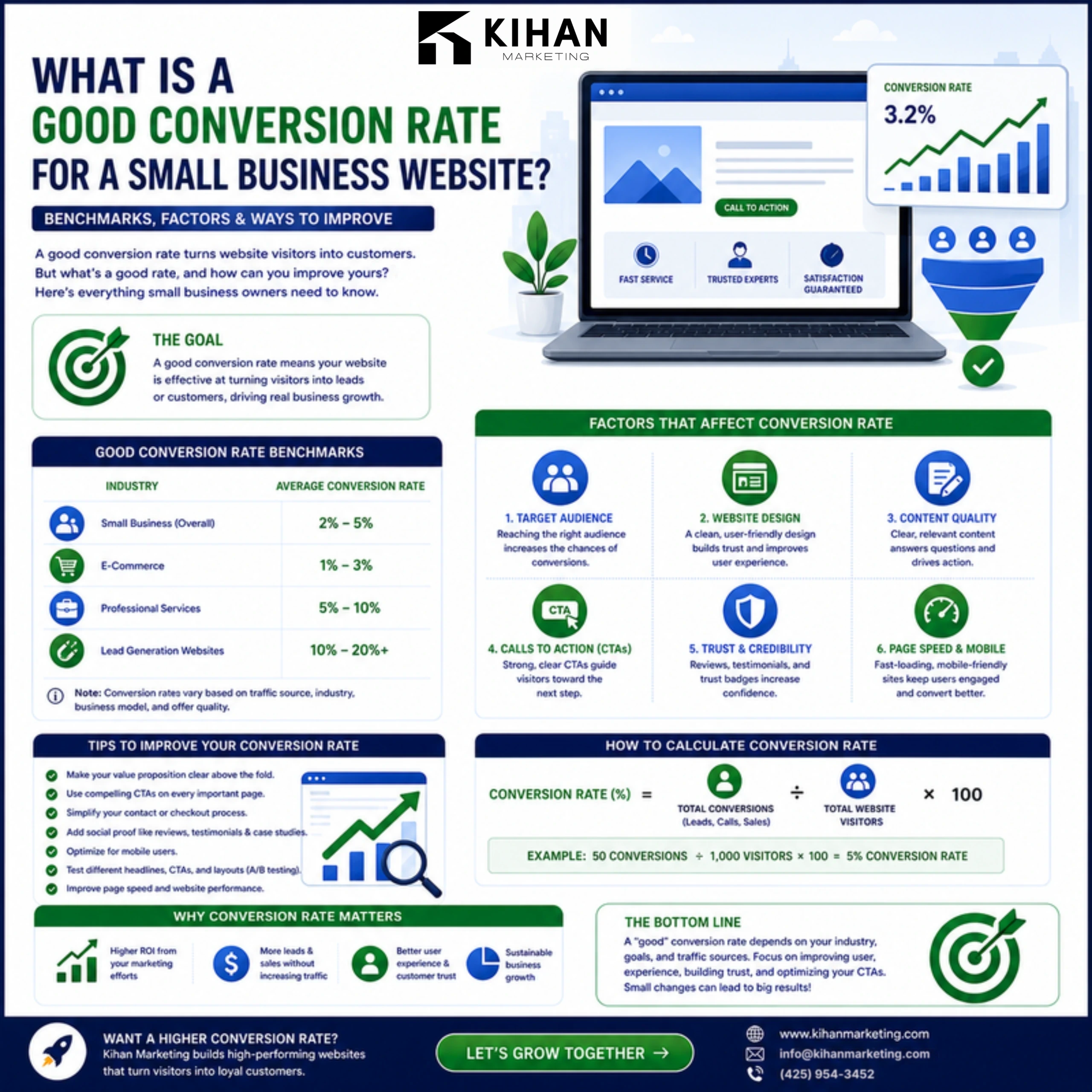
Across industries, a typical website converts around 2% to 3% of visitors. A good rate is often put at 2% to 5%. Service businesses with high local intent often beat that, because the visitor already wants the service. Treat these as guideposts, not gospel. Your own baseline matters more than any benchmark.
What Affects Your Conversion Rate
Your rate depends on traffic quality, page speed, a clear offer, easy contact, trust signals like reviews, and the mobile experience. A slow page or a buried phone number quietly kills conversions. The closer your visitors are to buying, the higher your rate tends to be.
How to Improve It
Speed up your site. Put click-to-call and simple forms on every screen. Sharpen your offer and add trust signals. Conversion-focused website development turns the traffic you already have into more leads. It is often the work that pays back the most.
Traffic vs Conversion
Double your conversion rate and you double revenue, without a single extra visitor. So before you pour budget into more traffic, make sure the traffic you have converts. Growth usually comes from fixing conversion first. Then you scale traffic into a site built for lead generation.
Related reading
- How to Track Marketing ROI for a Small Business
- Marketing Attribution: How to Know What’s Actually Working
- GA4 Setup for Small Businesses: A Step-by-Step Guide
What Is a Good Website Conversion Rate for a Small Business
A published number does not tell you much on its own. It only means something next to what is being counted and who is arriving.
It depends what counts as a conversion. A newsletter signup and a quote request are both conversions. Expecting the same rate from each compares two different things.
It depends who is arriving. Branded search, where people type your name, converts far better than a broad search for general information. A site with lots of early, just-browsing traffic will show a lower overall rate. It may still be the healthier site.
It depends on the price and the commitment. A cheap impulse buy and a big-ticket service will never convert at the same rate. Nor should they.
The only benchmark that matters is your own. Use last quarter, same page, same traffic source. Everything else is a conversation starter, not a target.
So ask a more useful question than what is normal. Of the people who land on the page that describes what you sell, how many take the next step? That number you can act on.
Measure It Properly Before Trying to Improve It
Count calls as well as forms. Most small business sites are judged on form fills. Yet most contact arrives by phone. A rate that ignores calls is wrong, usually by a lot.
Split by page, not sitewide. A sitewide rate averages your best page with your blog archive. It tells you nothing about either.
Split by traffic source. Paid, organic, branded and referral visits behave very differently. The blended figure hides which one is failing.
Split by device. Most small business traffic is on phones, so compare phone and desktop separately.
Say your desktop visitors convert twice as well as your phone visitors. Then the problem is the mobile layout, not the copy. Rewriting the words would not fix it.
Check the form actually works. Submit it yourself, on a phone, from outside your own network. This finds more conversion problems than any analysis.
The Changes That Move It Most
Here they are in rough order of effect for a small business site. None of them needs a redesign. For the short version, see How to Improve It above.
| Change | Why it works | Effort |
|---|---|---|
| Phone number visible on every screen | Most inquiries are calls, and people will not hunt | Minutes |
| One clear next step per page | Two competing calls to action perform worse than one | An hour |
| Shorter forms | Every extra field costs submissions, and the office can ask later | An hour |
| Answer price on the page | The most common reason people leave without contacting anyone | A morning, and a decision |
| Match the page to the ad or the search | Traffic landing on a homepage instead of the service converts far worse | Per campaign |
| Faster loading on mobile | Slow pages lose people before they see anything | Varies |
Traffic Versus Conversion: Which to Fix First
Almost always conversion, and the math is the reason. Doubling traffic takes months and costs money every month. Doubling the conversion rate multiplies every channel you already have. That includes the ones you have not started yet. Traffic vs Conversion above gives the short version.
The exception is a site with truly tiny traffic. There is not enough data to tell whether a change helped. Below a few hundred visitors a month, fix the obvious things listed above. Then get traffic, then optimize properly.
How Fast This Work Shows Up
Conversion work usually shows up faster than search work. It acts on traffic you already have, rather than waiting for new traffic to arrive. Common questions are answered in the FAQ on conversion rates below.
Website DevelopmentWebsites on WordPress, Next.js, Webflow and Framer, built to rank and to bring in leads.FAQ: Conversion Rates
What is a good website conversion rate?
Typically 2% to 5%, with the average around 2% to 3%. Service businesses with strong local intent often do better.
How do I calculate conversion rate?
Divide the number of conversions by total visitors, then multiply by 100. Fifty leads from 2,000 visitors is a 2.5% rate.
How can I improve my conversion rate?
Speed up the site, make contact obvious, sharpen your offer and add trust signals like reviews.
Is more traffic or higher conversion better?
Often higher conversion, because it grows revenue without extra ad spend. Fix conversion before you scale traffic.
What is a good conversion rate for a small business website?
There is no useful universal figure. It depends on what you count as a conversion, who is arriving and what you ask them to commit to. The benchmark worth using is your own page, last quarter, same traffic source.
Should I count phone calls as conversions?
Yes. Most small business inquiries arrive by phone. A rate based only on form fills understates how you are doing, often by a lot. It can also send you off to fix something that is not broken.
What improves conversion rate the fastest?
Make the phone number visible on every screen. Have one clear next step per page. Shorten your forms, and answer price. None of these needs a redesign, and all of them act on traffic you already have.
Should I fix traffic or conversion first?
Conversion, in almost every case. It multiplies every channel at once, while more traffic only adds one. The exception is a site with so few visitors that you cannot tell whether a change helped.
What is the average website conversion rate by industry?
Across industries, a typical site converts around 2% to 3% of visitors. Service businesses with high local intent often beat that, because the visitor already wants the service. Within any industry, the rate still moves with price, commitment and who is arriving. So compare your own pages over time before you compare yourself with an industry chart.
What counts as a conversion on a small business website?
Any action that moves a visitor toward becoming a customer. For most small businesses, that means a phone call, a quote request or a contact form. A newsletter signup counts too, but track it apart. It will never convert at the same rate as a quote request. And count calls, or your rate will read low.
Why is my website conversion rate low?
Usually it is one of a few fixable things. The page is slow, the phone number is buried, or the form is long or broken. The traffic may land on your homepage instead of the service it wanted. Or the rate simply ignores phone calls. Test the form on a phone first, then check the mobile layout.