


SaaS marketing for a small team comes down to one hard choice: where to put limited time and money. You cannot run every channel at once. This guide sorts the channels into the ones that compound and the ones that do not. Then it shows how to sequence them, how to split the budget, and how to tell if it is working.
Pick channels that compound, where each unit of effort keeps paying out long after you stop working on it. With a lean team and a modest budget, put 70% of your effort into one or two of those channels. Use paid ads only to validate. Measure everything against payback period, not vanity reach.
TL;DR
SaaS marketing for small business teams works when you pick channels that compound. SEO, content, product-led growth, and owned email compound. Paid ads, cold outreach, and most social do not. Put most of your effort into the first group, use paid only to test, and judge every channel by payback period.
What "Compounding" Actually Means in SaaS Marketing
Most marketing advice treats every channel as equal. It isn’t. For a small SaaS team, the most useful question about any channel is simple. Does it compound, or does it evaporate?
A compounding channel builds an asset that keeps working. Write one strong article that ranks, and it pulls qualified traffic every month for years. You pay nothing more to keep it. An evaporating channel rents attention. Stop paying for ads and the leads stop the same day. Nothing is left behind.
Small teams cannot win the evaporating game. You do not have the budget to outspend a funded rival on Google Ads. You do not have the headcount to reach scale through manual outbound. What you do have is the ability to build lasting assets that quietly add up. We are openly biased toward compounding channels. They are the only realistic path to lasting growth on a small budget. That bias shapes how we approach SEO for every client.
The Channels That Compound
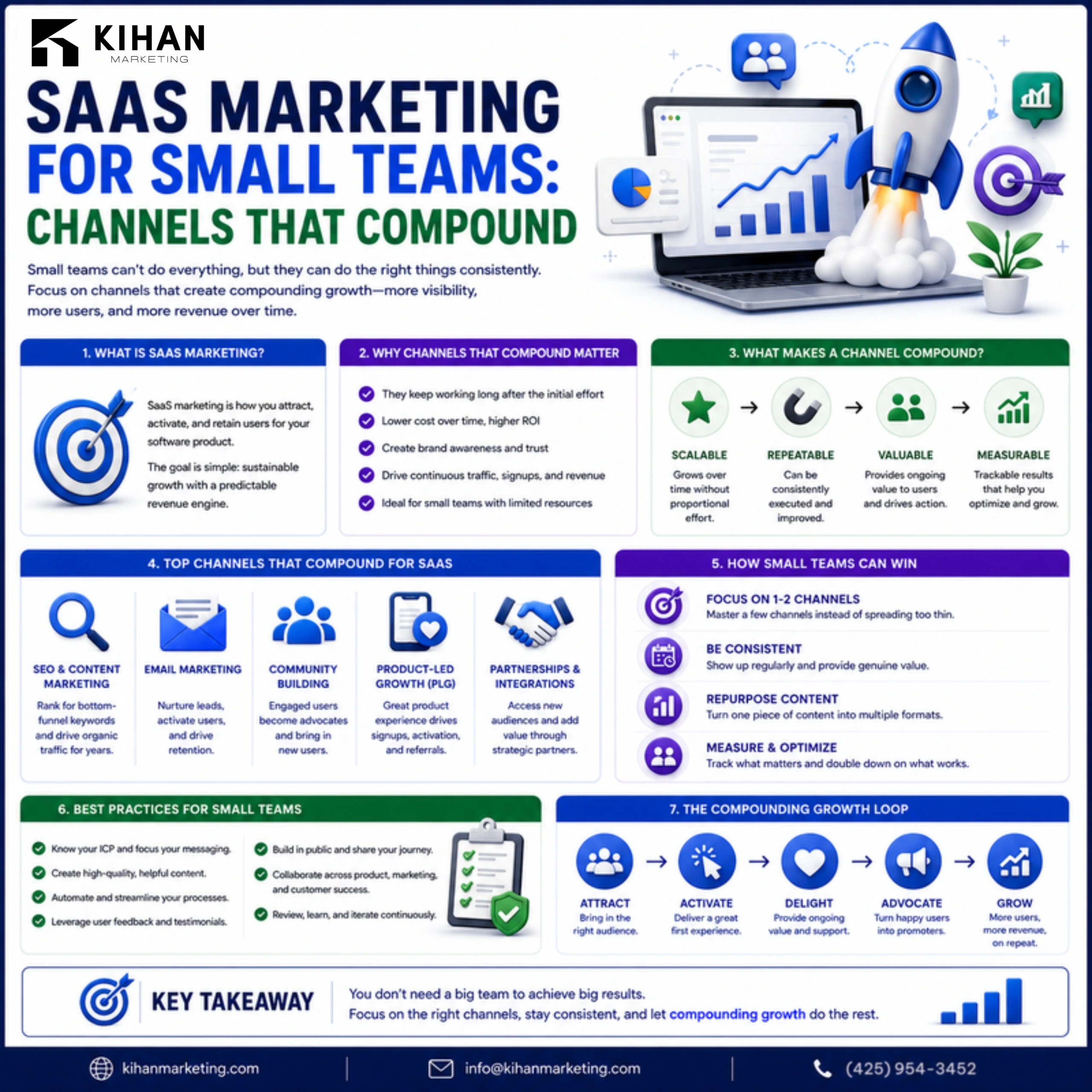
These four channels share one trait. The work you do today keeps paying off months and years from now.
Search engine optimization
SEO is the clearest compounding channel in software marketing. It keeps bringing in ready buyers long after the work is done.
Take a page that ranks for “best invoicing tool for freelancers” in search. That is a bottom-of-funnel query, typed by someone close to buying. The page draws buyers who are actively searching for a tool like yours. That traffic costs nothing extra per visit, and it grows as you publish more and earn authority.
The catch is the lag. SEO takes 4 to 9 months to gain traction. That is exactly why impatient teams quit right before it pays off.
Content and thought leadership
Content is the fuel SEO runs on, but it compounds beyond search too. A truly useful piece gets shared, cited, and linked. Each link makes everything else on your domain stronger. The goal is not volume. It is to publish pieces people come back to and point others to.
Product-led growth
Product-led growth (PLG) means your product itself brings in users. That can happen through a free tier, an output people share, or in-app invites. Growth then compounds inside the product, because each happy user can bring the next. PLG does not fit every SaaS. Where it works, it is the cheapest source of new users you will ever build.
Owned email and community
You own an email list outright. A social following is different: you rent it from a platform. Every subscriber you add grows the reach of every future send. Pair the list with a focused community and you have a lasting channel no algorithm can take away. This is the backbone of real lead generation, as opposed to one-off campaigns.
The Channels That Do Not Compound
We do not tell clients to avoid these entirely. We tell them to be honest about what they are buying.
- Paid search and social ads. Good for testing and fast feedback. But the moment you stop paying, the traffic dies. Returns rise in a straight line with spend and never compound.
- Cold outbound. It can book meetings, but every meeting takes fresh manual effort. It grows with headcount, not with leverage.
- Most organic social. A post peaks in 48 hours and then fades. The content rarely builds a lasting asset people can find by search.
- Influencer and sponsorship spots. A spike of attention that leaves nothing behind once the campaign ends.
Channel | Compounds? | Time to traction | Cost when you stop |
SEO | Yes | 4 to 9 months | Traffic continues |
Content | Yes | 3 to 6 months | Assets keep working |
Product-led growth | Yes | 2 to 6 months | Loop keeps running |
Owned email | Yes | 1 to 3 months | List remains yours |
Paid ads | No | Days | Leads stop instantly |
Cold outbound | No | Weeks | Pipeline dries up |
Organic social | Rarely | Weeks | Reach disappears |
The channels that do not compound still have value. They are tools for a job: testing a message, filling an early pipeline, or buying time while your lasting assets grow. The mistake is treating them as your growth engine.
How to Sequence Channels With a Small Team
A five-person company cannot run seven channels well. Trying to is the most common reason small SaaS teams stall. Take them one at a time instead.
- Validate the message with a small paid test. Spend a modest amount on ads or outbound just to learn which pitch converts. This is research, not your growth strategy.
- Build your first compounding asset. Pick SEO plus content, or PLG, depending on your product. Go deep on one before you add a second.
- Layer in owned email. Capture every visitor the compounding channel brings. Then you are not renting that attention again later.
- Add a second compounding channel only once the first one brings in pipeline you can predict.
- Keep paid as a dial, not an engine. Turn it up to speed up a launch. Turn it down when you need to protect margin.
The discipline here is saying no. Every channel you add splits a small team’s focus. Two compounding channels run well beat six run poorly every time. If search is your way in, our free marketing audit is a fast way to see whether the opportunity is real. Check that before you commit months to it.
A Realistic Budget and Time Allocation
Most small SaaS teams have less budget than they would like. Here is a split you can defend, for a team that puts compounding growth first. It works with whatever budget you have.
Allocation | Share | What it covers |
SEO and content | 50% | Writing, optimization, a few links |
Owned email and lifecycle | 15% | Tooling, sequences, newsletter |
Paid validation | 20% | Small, disciplined ad tests |
Tools and analytics | 15% | Tracking, attribution, automation |
For a lean team, time matters more than money. If your founders or first marketer put in the hours, split those hours roughly three ways. Give 70% to building compounding assets, 20% to testing and experiments, and 10% to measurement. The small teams that get this right guard that 70% fiercely. It’s the only part of the budget that keeps paying after the month ends.
Metrics That Tell You It Is Working
We are openly against vanity metrics. Impressions, follower counts, and raw traffic tell you almost nothing about whether the business is growing. Track these instead:
- Customer acquisition cost (CAC) by channel. Know what each channel really costs to land one paying customer.
- Payback period. How many months of revenue it takes to earn back CAC. Under 12 months is healthy for most small SaaS.
- Organic pipeline share. The share of new trials or demos that come from compounding channels. Watch it climb over time.
- Activation and retention. Marketing that drives signups who never start using the product is just costly noise.
If your compounding channels are working, organic pipeline share will rise quarter over quarter while blended CAC falls. That trend is the proof, not any single month’s traffic.
SEO and AI SearchHow we run SEO for businesses that need to be found: local, technical, schema and AI search.FAQ: SaaS Marketing for Small Business
What is the best marketing channel for a small SaaS company?
For most, it is SEO paired with content. It is the strongest compounding channel because it builds traffic that keeps growing without ongoing spend. The trade-off is a 4 to 9 month ramp before it pays off.
How much should a small SaaS spend on marketing?
Usually less than they think they need. What matters more than the number is focus. Put most of it into one or two compounding channels rather than spreading it thin across five.
Are paid ads worth it for a small SaaS?
Yes, for testing and short-term speed. They are not a lasting growth engine on a small budget, because returns stop the moment you stop paying. Use them as a dial, not the motor.
How long until SaaS marketing shows results?
Owned email can produce within weeks. Content and PLG take a few months, and SEO typically takes 4 to 9 months. Compounding channels are slow to start, but hard to stop once they take hold.
Can a small team really compete with funded SaaS competitors?
Yes, by refusing to play their game. You cannot outspend them on ads. But you can out-build them in lasting assets, like search rankings and an audience you own, that money alone cannot shortcut.
What is SaaS marketing?
SaaS marketing is how a software company finds, wins and keeps paying users. For a small team, it means choosing a few channels, such as SEO, content, product-led growth and owned email. It also means judging them by what each paying customer costs, how fast that cost is earned back, and whether signups stay.
How is SaaS marketing different from other marketing?
The sale does not end at signup. A SaaS product earns its revenue month by month, so marketing has to bring in users who start using the product and stay. That is why payback period, activation and retention matter more here than reach. The product itself can also be a channel, through free tiers and invites.
Can a founder run SaaS marketing without a marketing team?
Yes, if they sequence instead of spreading out. A founder or first marketer can start with a small paid test, then build one compounding channel and capture visitors by email. Most of their hours go to building those assets, with the rest on tests and measurement. A second channel comes only once the first is producing.
The small SaaS teams that grow steadily aren’t the ones with the biggest budgets. They’re the ones with the discipline to build assets that compound. Their rivals keep renting attention that they lose the moment the spend stops. Want help picking and building the right channel? Start with a free marketing audit, or see how we structure engagements on our SEO page.
Related reading