
Which Digital Marketing Strategies Work Best for E-commerce Brands

Ask AI to Summarize




TL;DR
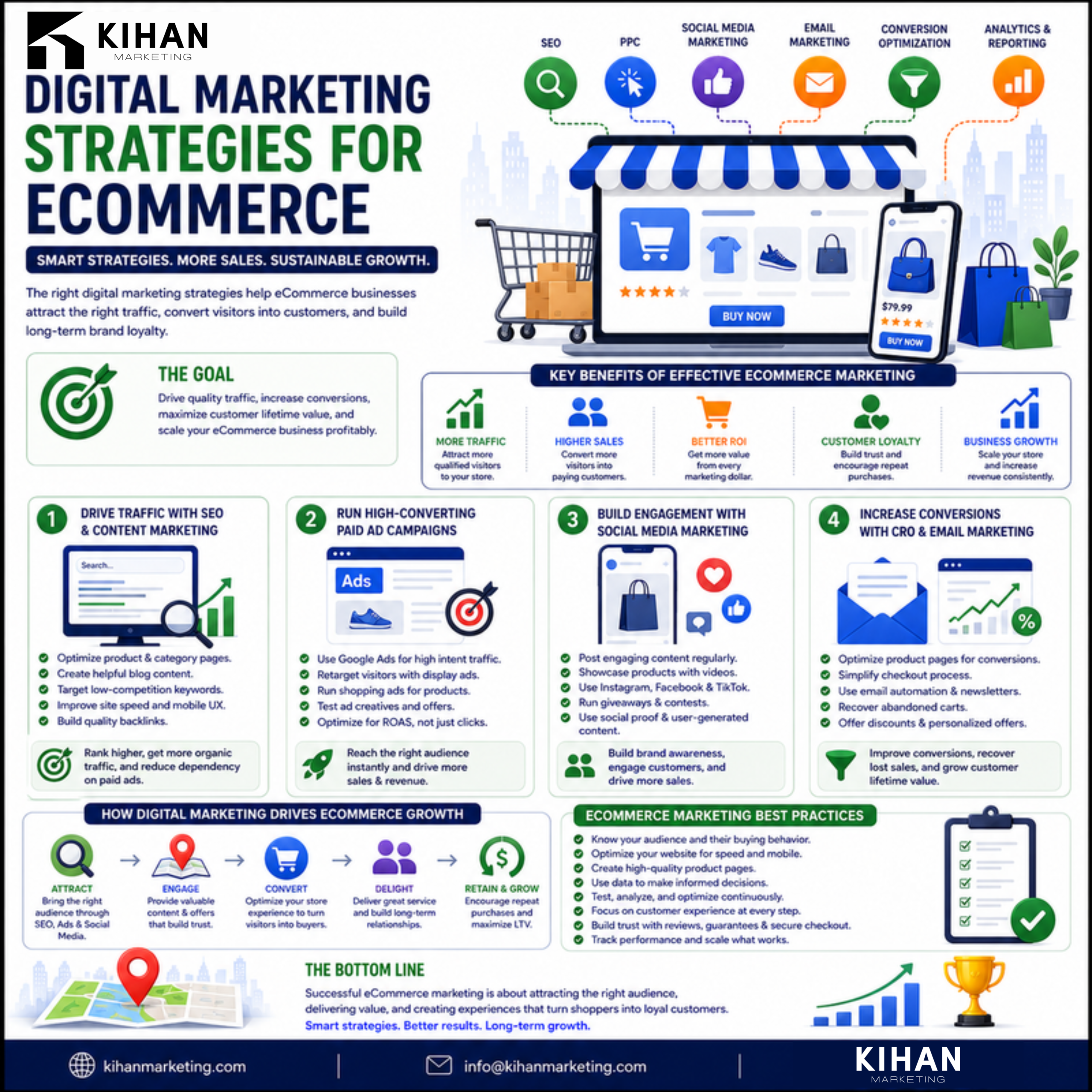
The digital marketing strategies that work best for e-commerce brands are product-focused SEO, shopping and paid social ads, email and SMS lifecycle marketing, and conversion rate optimization. The winning mix drives qualified traffic to optimized product pages, then maximizes repeat purchases through email. E-commerce lives and dies on unit economics, so every channel should be measured against customer acquisition cost and lifetime value.

Product and Category SEO
Organic search is the cheapest scalable traffic an e-commerce brand can get. Optimizing category and product pages for how shoppers actually search (including long-tail, high-intent queries) brings in buyers without paying per click. Strong SEO also reduces your dependence on ever-rising ad costs, protecting your margins as you scale.
Shopping and Paid Social Ads
Google Shopping puts your products in front of ready-to-buy searchers, while paid social (Meta, TikTok) drives discovery for visually-driven products. The discipline that separates winners is ruthless attention to return on ad spend, testing creative, audiences, and offers, and cutting what doesn’t beat your acquisition target. Ads scale fast, but only when the unit economics work.

Email and SMS Lifecycle Marketing
The real profit in e-commerce is in repeat purchases. Email and SMS flows (welcome, abandoned cart, post-purchase, win-back) turn one-time buyers into loyal customers at almost no marginal cost. A brand that nails retention can afford to spend more to acquire, which compounds every other channel. This is the highest-margin lever most stores underuse.
Conversion Optimization and Economics
Doubling your conversion rate doubles revenue without spending a cent more on traffic. Optimizing product pages, checkout, page speed, and trust signals is among the highest-ROI work in e-commerce. Tie it all back to the numbers that matter, customer acquisition cost and lifetime value, and every channel decision becomes clear. A fast, frictionless store is the foundation; see our approach to website development.
Related reading
Which Strategies Work Best, and for Which Kind of Store
There is no single answer, because a store selling one considered product and a store with four hundred low-priced items are different businesses wearing the same software.
| Type of store | What tends to carry it | What usually disappoints |
|---|---|---|
| Few products, considered purchase | Search, comparison content, email nurture | Broad paid social, because the decision is slow |
| Large catalog, low price point | Shopping ads, on-site search, lifecycle email | Long-form content on individual products |
| Visual and impulse driven | Paid social, creator content, retargeting | Category-page SEO against national retailers |
| Repeat consumable | Subscription mechanics, email and SMS, retention | Spending everything on acquisition |
Where Ecommerce SEO Actually Pays
Competing with national retailers on broad category terms is usually a losing fight for a small store. Three places are winnable.
The Numbers That Decide Whether Any of It Works
Ecommerce marketing is arithmetic more than it is creative. Four figures decide whether a channel is worth running, and most stores track two of them.
Email and SMS, Which Almost Every Store Underuses
The list is the only audience a store owns outright. Platform reach changes, ad costs rise, and search results shift, but an email list still works next year.
Four sequences cover most of the value: a welcome series that explains why you rather than a competitor, an abandoned checkout reminder, a post-purchase sequence that asks for a review and suggests what pairs with the order, and a reactivation message to people who have not bought in a while. Set up once, they run without ongoing spend.
What This Costs
| What | Published price | Terms |
|---|---|---|
| Website design and build | From $5,000 | One time, scope dependent |
| SEO | From $1,500 per month | Month to month, no long contract |
| Growth engagement | $3,000 per month | SEO, content and paid together |
Month to month, no long contract. Ad spend is paid directly to the platforms. For most stores the sequence that works is fixing the conversion basics first, then adding traffic, because paid traffic sent to a store that does not convert simply loses money faster.
FAQ: E-commerce Marketing
There’s no single best; the winning mix is SEO and shopping/social ads for acquisition plus email/SMS for retention, all judged on ROAS, CAC, and LTV.
Yes. Product and category SEO brings scalable traffic without paying per click and reduces your dependence on rising ad costs.
Critical. Repeat purchases drive e-commerce profit, and email/SMS flows convert at high margins with little marginal cost.
Yes for discovery, especially visual products, but only while the return on ad spend beats your acquisition target.
It depends on the store. Few products with a considered purchase are carried by search and email; large low-priced catalogs by shopping ads and lifecycle email; visual impulse products by paid social. The mistake is copying a strategy from a store with different economics.
Yes, on the right terms. Broad category keywords against national retailers usually are not winnable. Specific product variations, comparison queries and use case content are, and they attract buyers who are close to purchasing.
Up to your contribution margin per order, which is revenue minus product cost, shipping, payment fees and returns. If customers reliably buy again you can spend more than a single order’s margin; if they do not, you cannot.
Email and SMS. A welcome series, an abandoned checkout reminder, a post-purchase sequence and a reactivation message cover most of the value, run without ongoing ad spend, and reach an audience the store actually owns.