For U.S. law firms, the most effective link-building program is quality-first and local-first: prioritize editorial placements, legal directory listings, and digital PR over volume. Start this week with three moves:
- Claim and complete your profiles on Justia, Avvo, and FindLaw, plus your state bar directory.
- Set up HARO and Qwoted alerts for legal, personal finance, and local news queries so you can respond to journalist requests within the hour.
- Audit your site for unlinked mentions using Google Alerts and Ahrefs, then send reclaim emails before building a single new link.
These three actions cost almost nothing, carry zero ethical risk, and produce results faster than any cold outreach campaign you could launch from scratch.
Table of Contents
- What are backlinks, and why do they matter for law firms?
- Why does link building matter specifically for law firms?
- What are the most effective link-building tactics for law firms?
- What ethical rules govern link building for lawyers?
- Which tools help you find and track link opportunities?
- What does a 6-month link-building plan look like for a law firm?
- Key Takeaways
- The case for doing this right, not just doing it fast
- How Kihanmarketing helps law firms build authority through links
- Useful sources and tools
What are backlinks, and why do they matter for law firms?
A backlink is any hyperlink from an external website pointing to yours. Search engines treat these links as votes of confidence, and the legal vertical is one of the most trust-sensitive categories on the web. Google’s quality raters explicitly evaluate legal content under E-E-A-T (Experience, Expertise, Authoritativeness, Trustworthiness), which means the source of a link matters as much as the link itself.
The practical difference shows up fast. A profile link from a generic directory tells Google your firm exists. An editorial citation in a regional newspaper’s coverage of a local court ruling tells Google your firm is a credible source on that topic. Both are backlinks; only one moves your rankings.
Three categories of links that actually build authority for legal websites:
- Foundational directory links: Justia, Avvo, FindLaw, and your state bar profile. These establish baseline legitimacy and are defensible links a legal professional would still endorse even if Google’s algorithm changed tomorrow.
Why does link building matter specifically for law firms?
Legal searches are high-intent and high-competition. A prospective client searching “personal injury attorney Chicago” is ready to hire, and the firms ranking in the top three positions capture the overwhelming majority of those clicks. Backlinks remain one of the strongest ranking signals, and in a vertical where every competitor is producing content, links are often the deciding factor between page one and page two.
The trust dimension is unique to legal. Clients choosing an attorney are making a high-stakes decision. A law firm that earns citations from the local bar association, a regional newspaper, and a legal aid nonprofit signals credibility in a way that a firm with 200 low-quality directory links simply cannot.
Beyond rankings, quality backlinks drive referral traffic from people who are already reading about legal topics, which means the visitors arriving through those links convert at a higher rate than cold organic traffic. Off-page citations and local directory listings improve local search visibility and directly influence whether your firm appears in the Google Maps pack for local searches.
Key benefits law firms see from a well-run link-building program:
- Higher rankings for competitive practice-area keywords
- Increased referral traffic from legal publications and local news
- Stronger local pack visibility for city and neighborhood searches
- Improved E-E-A-T signals that protect rankings during algorithm updates
- More qualified leads from readers already in a legal research mindset
What are the most effective link-building tactics for law firms?
The tactics below are ranked by expected ROI and ethical safety. Run them in order if you’re starting from scratch; layer them simultaneously once you have the infrastructure in place.
1. Foundational directory and association listings
Why it works: These links establish your firm’s baseline legitimacy and are the first thing Google looks for when evaluating a new legal website. Quality-focused tactics like directory presence and local engagement produce the best foundational results.
How to execute:
- Claim and fully complete profiles on Justia, Avvo, and FindLaw with consistent NAP (name, address, phone) data.
- Submit to your state bar’s attorney directory and any specialty bar associations relevant to your practice areas.
- Verify that every profile links to the same canonical URL on your website.
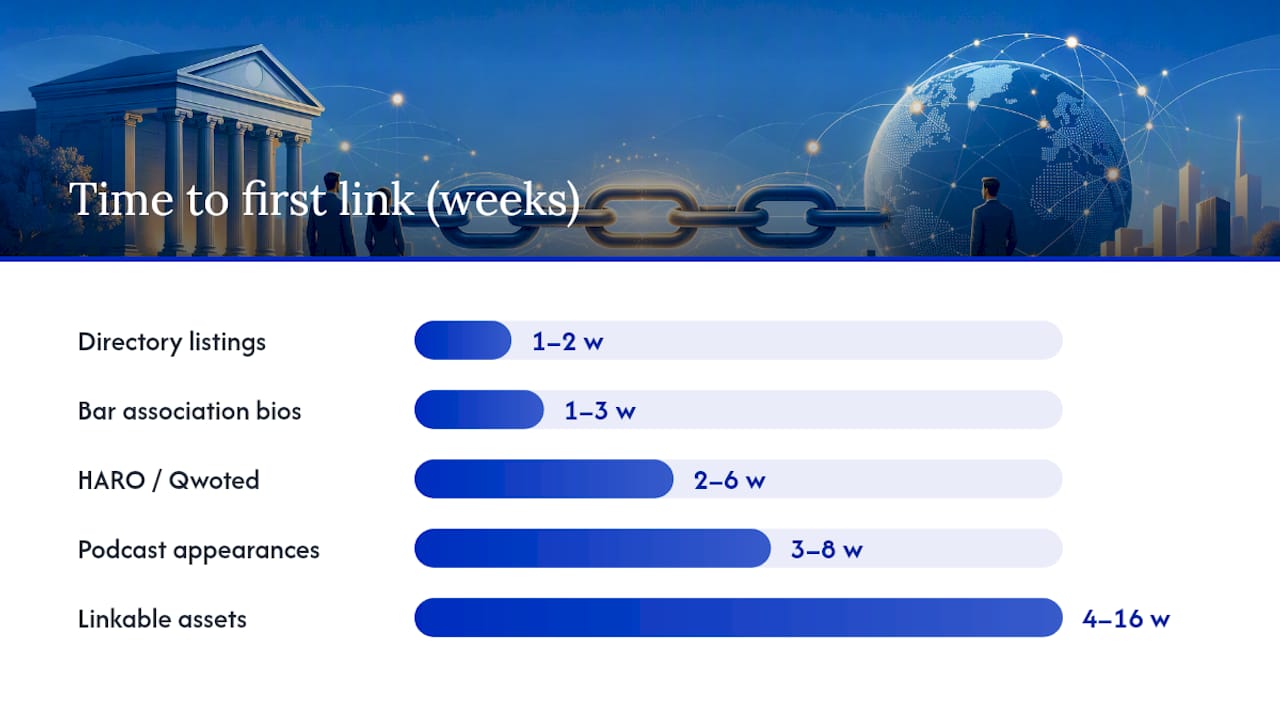
Typical time to first link: 1 to 2 weeks.
2. Attorney bios and bar membership pages
Why it works: Bar association profile pages carry institutional authority and are editorially controlled, meaning Google treats them as trust signals rather than self-promotional placements.
How to execute:
- Log into your state bar member portal and update your bio with a link to your firm’s website.
- Do the same for any specialty bar associations (ATLA, NAELA, NELA, etc.).
- Check that your law school alumni directory includes a current firm link.
Typical time to first link: 1 to 3 weeks.
3. HARO and Qwoted journalist outreach
Why it works: Journalists actively need legal expert sources, and a well-timed quote earns an editorial citation from a publication you could never cold-pitch successfully. The DC Bar explicitly recommends HARO and Qwoted as link-earning tactics for lawyers.
How to execute:
- Create accounts on HARO (Help a Reporter Out) and Qwoted; set keyword alerts for “attorney, ” “lawyer, ” your practice area, and relevant legal topics.
- Respond within two hours of a query posting. Journalists work on deadlines; late responses rarely get used.
- Keep responses under 200 words, lead with the direct answer, and include your bar number and firm name for credibility.
Typical time to first link: 2 to 6 weeks per placement.
4. Guest articles in legal and local publications
Why it works: A bylined article in a legal trade publication or local business journal earns an editorial link, builds brand authority, and often generates referral traffic from readers who are already in a legal research mindset.
Target site categories: state bar journals, legal niche blogs, local business publications, law school alumni magazines, and ABA-affiliated channels.
How to execute:
- Identify three to five publications that accept attorney contributions and review their submission guidelines.
- Pitch a specific, timely topic tied to a recent court decision, legislative change, or local legal trend.
- Include a brief author bio with a link to your firm’s practice area page, not just the homepage.
Typical time to first link: 4 to 10 weeks.
5. Local news and community sponsorships
Why it works: Regional newspapers, local TV station websites, and community blogs link to sponsors and expert sources. These links are geographically relevant, which directly supports local pack rankings.
How to execute:
- Sponsor a local event, legal aid clinic, or community organization and confirm that the sponsorship includes a website link.
- Pitch your attorneys as expert commentators to local news reporters covering legal topics.
- Offer a free consumer-facing legal guide (e.g., “What to Do After a Car Accident in [City]”) to local news sites as a resource they can link to.
Typical time to first link: 2 to 8 weeks.
6. Scholarship pages (.edu links)
Why it works: University financial aid and scholarship pages carry high domain authority and are editorially maintained. A law firm scholarship for pre-law students earns a link from a.edu domain that is nearly impossible to replicate through other tactics.
How to execute:
- Create a scholarship page on your website with clear eligibility criteria and an application process.
- Email financial aid offices at regional law schools and undergraduate institutions with a brief pitch.
- Budget $1,000, $2,500 per year for the award; the link value typically exceeds the cost in competitive markets.
Typical time to first link: 6 to 12 weeks.
7. Reclaiming unlinked mentions
Why it works: Law firms are frequently mentioned in news articles, court coverage, and legal blogs without a hyperlink. Converting those mentions into links is the highest-ROI tactic available because the editorial decision to reference your firm has already been made.
How to execute:
- Set up Google Alerts for your firm name, lead attorneys’ names, and common misspellings.
- Use Ahrefs Content Explorer or Semrush’s Brand Monitoring tool to find unlinked mentions at scale.
- Email the author or editor with a brief, friendly note: “I noticed you mentioned [Firm Name] in your article on [topic]. Would you consider adding a link to our website for readers who want to learn more?”
Typical time to first link: 1 to 3 weeks per reclaim.
8. Linkable assets (guides, checklists, local data)
Why it works: A genuinely useful resource earns links passively over time. Digital PR that leverages attorney expertise on public legal data, court trends, or local statistics creates commentary that regional press and niche sites reference repeatedly.
Target asset types: state-specific legal guides, court process checklists, local accident data analysis, consumer FAQ pages, and interactive tools (e.g., statute of limitations calculators).
Typical time to first link: 4 to 16 weeks after publication.
9. Podcast appearances and expert quote roundups
Why it works: Legal podcasts and expert roundup articles often include show notes or contributor bios with links. These are low-effort placements that also build brand awareness.
How to execute:
- Search “[practice area] podcast” and “[city] legal podcast” to identify shows that feature attorney guests.
- Pitch a specific topic tied to a recent case or legal development, not a generic “I’m an expert” pitch.
- After the episode publishes, confirm the show notes include a link to your firm’s website.
Typical time to first link: 3 to 8 weeks.
Tactic comparison at a glance:
| Tactic | Effort | Link Quality | Time to First Link |
|---|---|---|---|
| Directory listings | Low | Moderate | 1 to 2 weeks |
| Bar association bios | Low | High | 1 to 3 weeks |
| HARO / Qwoted | Medium | High | 2 to 6 weeks |
| Guest articles | High | High | 4 to 10 weeks |
| Local sponsorships | Medium | High (local) | 2 to 8 weeks |
| Scholarship pages | Medium | Very high | 6 to 12 weeks |
| Unlinked mention reclaim | Low | High | 1 to 3 weeks |
| Linkable assets | High | Variable | 4 to 16 weeks |
| Podcast appearances | Low | Moderate | 3 to 8 weeks |
What ethical rules govern link building for lawyers?
Bar advertising rules apply to digital marketing, and link building is not exempt. The ABA Model Rules of Professional Conduct, particularly Rules 7.1 through 7.5, govern attorney communications about services. Most state bars have adopted versions of these rules, and several states (California, New York, Florida, Texas) have additional advertising requirements.
Do:
- Keep all content used to earn links accurate and non-misleading under ABA Rule 7.1.
- Label any sponsored content or paid placements as advertising where required by your state bar.
- Obtain client consent before using case outcomes, testimonials, or client-identifiable information in any content that earns links.
- Maintain a log of every third-party link acquisition, including the tactic used, the publication, and the content involved.
Don’t:
- Buy links through schemes that require a misleading endorsement or a fake editorial placement. This violates both Google’s guidelines and, in many states, bar advertising rules.
- Use client case details in linkable content without explicit written consent, even anonymized details that could identify a client.
- Claim specialization or certification in a guest article unless your state bar has certified you in that area.
- Allow a third-party agency to publish content under your name without reviewing it for accuracy and bar compliance.
Pro Tip: Keep a simple compliance log: a spreadsheet with columns for the publication, the content title, the link URL, the tactic used, and a “reviewed for bar compliance” checkbox. If your state bar ever questions a placement, this log is your first line of defense.
High-quality, relevant backlinks should be earned, not bought, and that principle aligns perfectly with bar advertising rules. The tactics that comply with bar guidance are also the ones that produce durable SEO results.
Which tools help you find and track link opportunities?
You don’t need a large tech stack to run an effective program. These tools cover the full workflow from prospecting to reporting:
| Tool | Type | Primary use case for law firms |
|---|---|---|
| Ahrefs | Paid | Backlink audits, competitor gap analysis, unlinked mention discovery, page-level traffic checks |
| Semrush | Paid | Keyword research, backlink monitoring, brand mention alerts, local SEO audits |
| HARO (Help a Reporter Out) | Free/Paid | Journalist query alerts for legal expert sources |
| Qwoted | Free/Paid | Journalist query platform; often less competitive than HARO for legal queries |
| BrightLocal | Paid | Local citation audits, NAP consistency checks, local rank tracking |
| Google Business Profile | Free | Local pack visibility, entity signals, review management |
| Google Alerts | Free | Unlinked mention monitoring for firm name and attorney names |
| Backlinko / Moz Link Explorer | Free tier | Spot-checking domain authority and link context |
Free vs. paid tradeoffs: Google Alerts and HARO are table stakes and cost nothing. Ahrefs or Semrush is worth the monthly fee once you’re running active outreach, because manual prospecting without a backlink database is slow and incomplete. BrightLocal is the right call specifically for local citation work, where its audit depth exceeds what Semrush’s local tools offer.
Free tools and PR-focused tactics like HARO and Google Alerts are practical starting points for firms that aren’t ready to invest in a full paid stack.
What does a 6-month link-building plan look like for a law firm?
This plan is structured around the sequencing that produces the fastest authority gains: foundational links first, then editorial outreach, then asset-driven and PR-led acquisition.
| Month | Tasks | Outputs | Est. Hours |
|---|---|---|---|
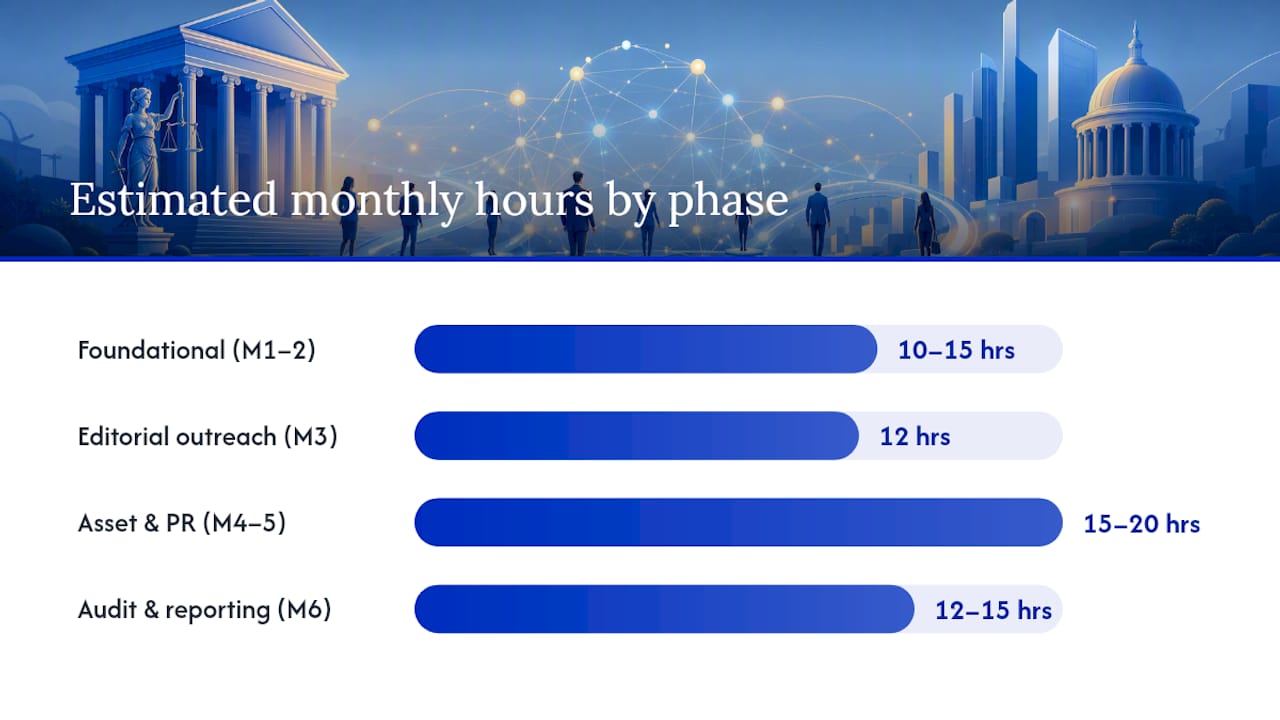
| Month 1 | Directory claims (Justia, Avvo, FindLaw, state bar); Google Business Profile optimization; Google Alerts setup; HARO/Qwoted account creation | 5 to 8 foundational links; GBP fully optimized | 10 to 15 hrs |
| Month 2 | Unlinked mention audit and reclaim outreach; bar association bio updates; law school alumni directory submissions | 3 to 6 reclaimed links; 2 to 4 association links | 10 to 12 hrs |
| Month 3 | First guest article pitch and submission; HARO/Qwoted active response (daily); local chamber of commerce submission | 1 to 2 editorial links; 2 to 4 HARO placements | 12 hrs |
| Month 4 | Linkable asset creation (city-specific legal guide or checklist); local news PR pitch; scholarship page launch | 1 asset published; 1 to 3 local news links | 15 to 20 hrs |
| Month 5 | Asset promotion outreach to legal blogs and resource pages; podcast pitch to 3 to 5 local/legal shows; scholarship outreach to law schools | 3 to 6 asset links; 1 to 2 podcast links; 2 to 4.edu links | 15 to 20 hrs |
| Month 6 | Full backlink audit; competitor gap analysis; second guest article; reporting and plan refinement | 2 to 4 additional editorial links; audit report | 12 to 15 hrs |
Budget range: A solo or small firm running this program in-house should budget 10 to 20 hours per month of staff or attorney time. Outsourcing to an agency typically runs $1,500, $4,000 per month for a program of this scope, depending on the market’s competitiveness.
Proof point: Kihanmarketing reduced a legal services client’s cost-per-lead from $85 to $42 by combining editorial link building with targeted local SEO, demonstrating that authority-building and lead generation move together when the program is structured correctly.
Key Takeaways
A quality-first, local-first link-building program that combines foundational directories, editorial outreach, and digital PR is the most defensible and highest-ROI approach for U.S. law firms.
| Point | Details |
|---|---|
| Start with foundations | Claim Justia, Avvo, FindLaw, and state bar profiles before any outreach campaign. |
| Prioritize editorial links | HARO, Qwoted, and guest articles earn high-authority links that directories cannot replicate. |
| Local links drive local leads | Google Business Profile, chamber listings, and regional news citations directly improve Maps pack rankings. |
| Measure referring domains, not raw links | Track unique linking domains monthly; tie traffic and conversion data to specific practice area pages. |
| Kihanmarketing builds the full program | Kihanmarketing handles link audits, editorial outreach, and local SEO for law firms, with results measured in leads and cost-per-lead, not vanity metrics. |
The case for doing this right, not just doing it fast
Most law firms that struggle with link building are not failing because they lack effort. They’re failing because they’re chasing volume in a vertical where trust is the actual currency.
The legal industry is one of the few categories where a single editorial link from a credible source, a state bar publication, a regional newspaper, a law school resource page, can outperform 50 directory submissions in terms of ranking impact. That’s not a theory. It’s the consistent pattern that emerges when you look at which firms dominate competitive practice-area searches in major U.S. markets.
There’s also a compliance dimension that most generic SEO advice ignores entirely. Bar advertising rules are not a technicality. They govern what you can say, how you can say it, and what endorsements you can use. A link-building tactic that works fine for a plumber can create a bar complaint for an attorney. That’s why the tactics in this playbook are sequenced the way they are: the safest and most effective options come first.
One thing worth saying plainly: hiring an agency to run your link-building program is not a shortcut. It’s a resource decision. If your firm has the internal bandwidth to run HARO responses daily, pitch guest articles monthly, and manage local PR outreach, do it in-house. If it doesn’t, an agency that specializes in legal digital marketing will produce results faster and with fewer compliance risks than a generalist. The red flag to watch for is any agency that promises a specific number of links per month without discussing quality, relevance, or bar compliance. That’s a volume play, and volume is exactly what you don’t need.
*, Kihan
How Kihanmarketing helps law firms build authority through links
Law firms that want to build a complete digital marketing strategy without managing every moving part in-house have a clear alternative: Kihanmarketing’s legal SEO program covers the full link-building workflow, from an initial backlink audit to editorial outreach, local citation management, and Google Business Profile optimization.
The program is built around the same quality-first approach this article describes: foundational directory links, HARO and Qwoted outreach, local PR pitching, and linkable asset creation, all measured against referring domain growth, organic traffic, and cost-per-lead. Kihanmarketing’s track record includes cutting a client’s cost-per-lead from $85 to $42, and every engagement is structured around revenue impact rather than link counts.
If your firm is ready to move from guessing at link opportunities to running a structured, ethics-compliant program, request a link audit to see exactly where your backlink profile stands and which opportunities are worth pursuing first.
Useful sources and tools
- Link Building for Lawyers: A Complete Guide
- Nine SEO Fundamentals for Lawyers
- SEO for Lawyers: How to Optimize Your Law Firm Website
- 5 Valuable Link Building Strategies For Law Firms, Forbes
- SEO for Law Firms: The Complete Guide to Client Acquisition Through Search, Marketing By Kevin
- Link Building for Law Firms: A Complete UK + US Guide, Link Building Journal
- Link Building for Law Firms | 7 Free Tools to Boost Your Backlinks
- Search Engine Ranking Factors, Backlinko
- Justia
Recommended
- Aesthetic Practice SEO: Outrank the Big Chains
- LinkedIn Marketing for B2B: Organic Growth Tactics
- Local SEO for Dental Practices: Attract New Patients
- Google Local Service Ads for Roofers: 2026 Guide
Article generated by BabyLoveGrowth
Key takeaway
The most effective link-building program for a US law firm is quality-first and local-first: editorial placements, legal directory listings, and digital PR over volume. Three moves cost almost nothing and carry zero ethical risk: complete your Justia, Avvo, FindLaw and state bar profiles, set journalist-request alerts, and reclaim unlinked mentions before building anything new.
Frequently asked questions